The new Brompton Electric with the e-Motiq system marks a quiet shift in how Brompton thinks about power. The motor is lighter, the controls are simpler, and the software observes how you ride before predicting range. In his book, Engineering for Change, Brompton CEO Will Butler-Adams writes that Brompton develops products by “pull, not push”; progress happens only when the learning is ready. Two decades of experiments, partnerships, dead ends, and breakthroughs have led to this moment. The result is Brompton’s first true integration of hardware, software, and behaviour. We’re here to tell the story.
Engineering Change
Many readers know that before Pedaal existed, we managed another shop and were the first retailer to import Brompton into Canada. Those early years of incubation were our apprenticeship and today, Pedaal is the expression of what we learned. If we’ve thrown all of our energy behind Brompton it’s because we believe, as Will Butler-Adams does, that Brompton isn’t just a bike. It is a tool that engineers change.

To help unpack “Engineering Change,” we might ask: what is transport and what is sport? Transport is about moving people or goods for a practical purpose, while sport is a leisure activity involving sweat or competition. Most bikes on the market are designed for sport. They are designed for recreation outside the city. This is where Bromptons are categorically different.

Unlike a sport bike, a Brompton is designed as a tool for life inside the city, and life inside the city involves a constant circulation of going indoors and outdoors. That means a bike that is as good indoors as it is outdoors. And, if you think a Brompton’s indoor life sacrifices its outdoor activity, think again. After all what other bike easily goes inside your camper-van, or inside a train as you hop around Europe? Brompton is a curious little bike. But, if you start asking it questions, it offers some electrifying solutions. The electric Brompton is one such answer.
Dark Arts
It was 2006, and I was visiting Brompton for the first time. I had been importing Bromptons for two years, and, like any owner of a Brompton, I needed to know what mad genius produced such a bike. It was time to visit the mothership. I arrived at the old Brentford factory and CEO Will Butler-Adams met me at the door. We clicked immediately. Besides sharing very eccentric bosses, Will had just become the General Manager of Brompton and saw something in the fold that went beyond clever engineering. Both of us believed this is a bike that could engineer change.
Will started the tour with a preface. “Before I take you on this tour,” he said, “I want to say one thing.” “What’s that?” I asked. He responded: “one thousand, two hundred proprietary parts.” Huh? By the end of the tour I saw very clearly what made Brompton so special. Here they were, brazing frames with brass, something Will called a “dark art,” and resembling something like a medieval guild. At the same time, machines were spitting out all sorts of proprietary parts. A visit to the tooling section, where all the tools were made to produce these frames and parts was like the holy of holies. But, at the end of the tour, Will led me outside and rolled out a prototype. It was a Brompton with a motor. I was still pulling everything I just saw – too dazzled! – to quite see the future. But, I sensed he was looking ahead.

A long ways ahead. It took twelve more years before the first Brompton Electric was pulled together. And now, eight years later, a completely new system has arrived. The story is really one of pull versus push.
Pull first, then push
Brompton calls their new electric system the e-Motiq. This might be an inside joke. In project management, MOTIQ stands for Money, Organization, Time, Information, and Quality. If you read Will Butler-Adam’s Engineering for Change, you can feel how all five shaped the first electric Brompton. Quality was non-negotiable; money and information were always scarce and this made organization the hardest problem. And, all of this explains why it took so much time to pull the first bike together. In his book, Will Butler-Adams argues that innovation must be pulled and not pushed into existence. In his eyes, you cannot start with a push because the foundation isn’t ready; first you gather the learning and the structure, then you push. That takes Time. It may be a fitting irony that the new e-Motiq motor pushes the rider from the rear wheel rather than pulling from the front. You might say that the first front-wheel Brompton Electric hadn’t quite pulled the full mission together.
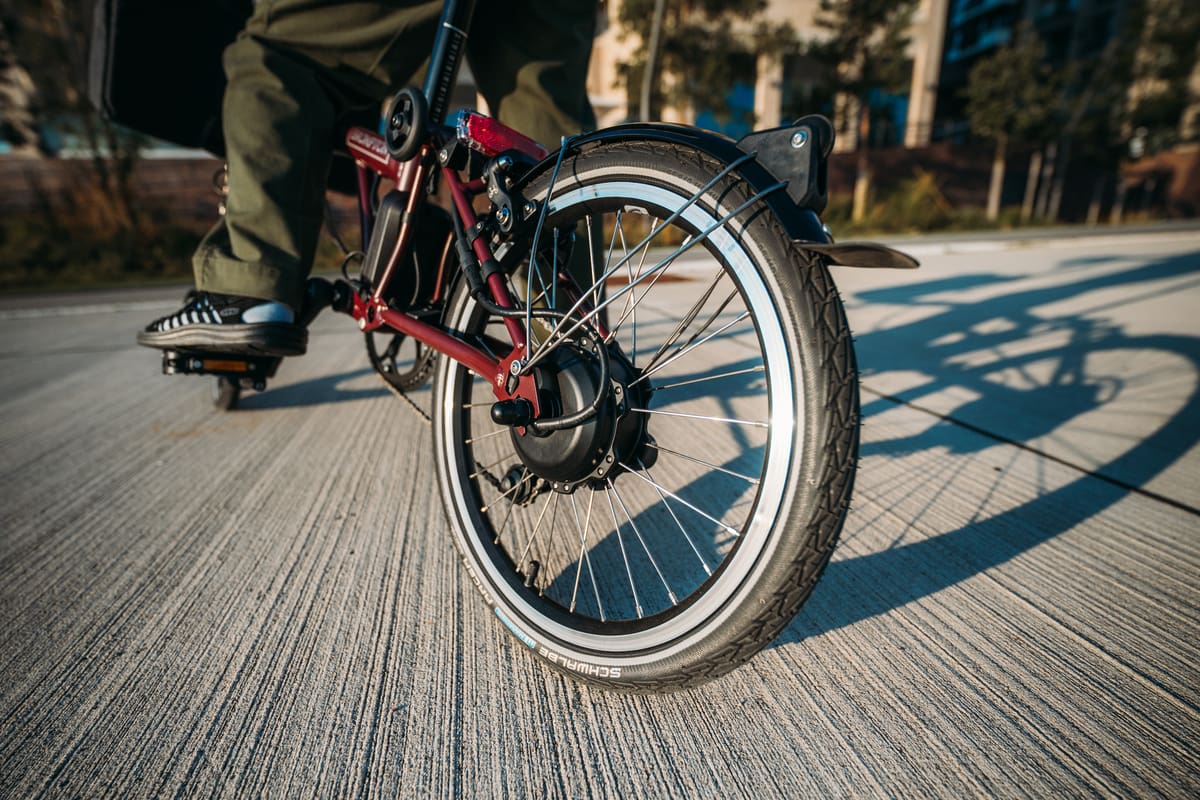
Speaking of “proper” it also needs to be said that no matter what, rear-hub power has always made more sense than a front-hub motor. On any bike, the rear wheel provides acceleration while the front wheel provides steering. Putting torque where the acceleration occurs puts power in the right place. It also ensures that handling isn’t compromised. In fact, it should be no surprise that the launch bike for the new e-Motiq system is the Brompton G-Line, a bike that is designed to not only ride through potholed city streets, but higher speed off-road riding. With a rear-hub motor, Brompton put the power behind your brain rather than in front of it. That’s because when it comes to handling decisions, you’re still smarter than the motor.

Motiq: Motor + IQ
We’ve speculated that the name “e-motiq” has something to do with Money, Organization, Time, Information, and Quality, but it could also be a combination of “Motor” and “IQ.” Again, we’re just speculating. But, with the development of the e-Motiq, Brompton has moved away from engineering hardware to developing the bikes actual behaviour.
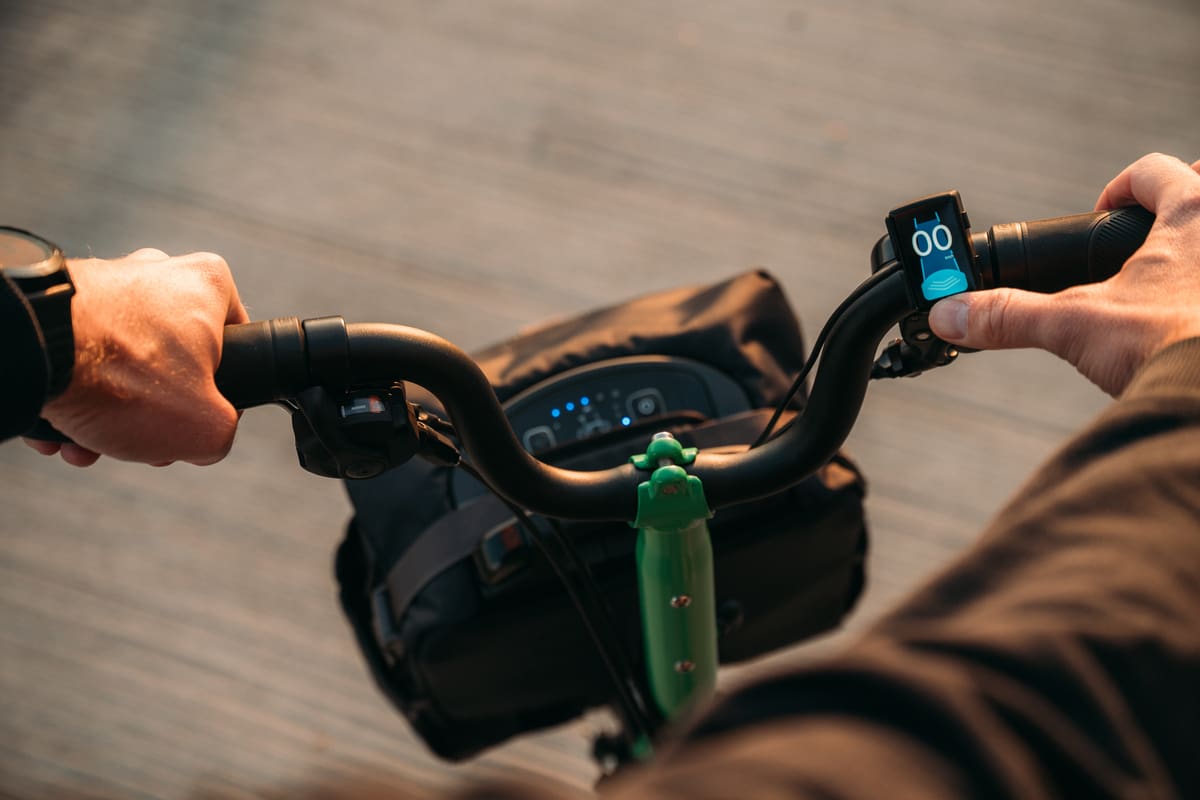
This meant developing software. Like all good electric bikes on the market, the e-Motiq is a pedelec. At its heart is a sophisticated computer that gathers the riders input and interprets it into a highly variable output. This interpretation is everything. The judge of a good pedelec system is how it works with the rider. That’s why it reads the riders torque, pedalling RPM’s and wheel RPM’s to compute the proper output. Ride up a hill and your torque increases while your wheel and pedalling RPM’s decrease. The e-Motiq reads this and boosts power up the hill and recedes to the background when you crest the hill. It never overpowers you, it never feels underpowered. All very well, but the e-Motiq takes this a step further.
The IQ in Motiq
The e-Motiq system does something no previous Brompton has done: it learns. During the first hundred kilometres, the motor spends less time assisting and more time observing — how hard you push on the pedals, how quickly you accelerate from a light, how your cadence changes on hills, how stop-and-go your commute is. As your profile develops, the Brompton begins refining its predictions about how far you can ride and how much power you actually need.
After that initial learning period, range estimates become specific to you rather than theoretical; the handlebar display updates dynamically as conditions change, and the companion app continues improving its estimates as you ride . Reviewers point out that this makes the assist feel less like switching modes and more like being supported at the right moment, without having to think about it. That’s the IQ!
Take the Stairs
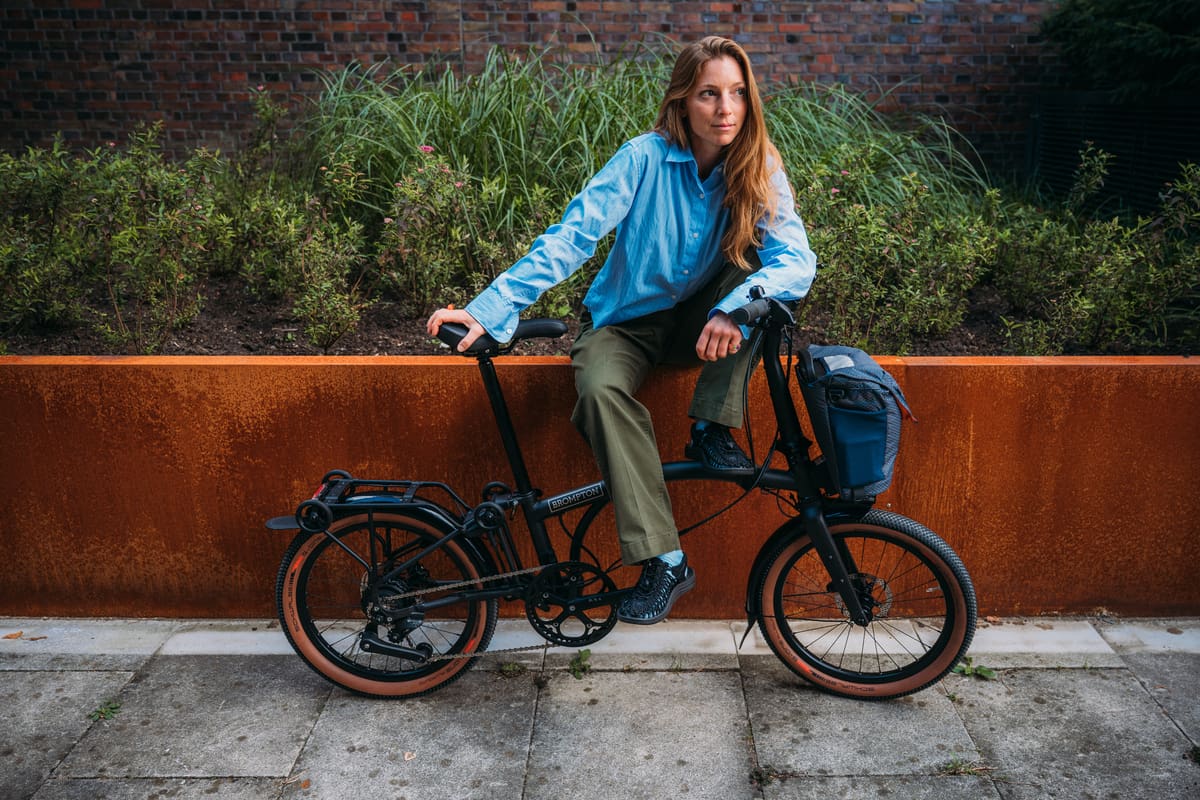
If this isn’t enough, the new e-Motiq has several other improvements as well. Range has been bumped up to 90km and the system weighs about one pound less than the previous front-wheeled version. But, like the previous version, the battery detaches so that the bike is lighter to carry up long flights of stairs. And, this is seriously a very lightweight bike. Without the battery, the C-Line weighs in at a mere 36lb, the P-Line weighs in at 34lb, and the T-line at an impressive 26lb. We’re not sure anyone can compete with that.

But, what about torque? Many people have commented that the e-Motiqs 24nm of torque is underpowered. That’s simply not true. Today, systems like Bosch and Shimano offer 85nm on their top end systems, and people seem to think it’s automatic that Brompton would do the same. But, this isn’t the case with a smaller wheel. On an e-bike with a big 700c wheel, torque has to travel through a large radius before it hits the road; on a Brompton’s small 16” wheel, that radius is tiny, so the same torque creates more punch. In other words, a small wheel multiplies force. This helps the reader also understand why Brompton needed to produce their own motor.
Do you have the MOTIQ?
The real problem with developing a motor for a Brompton is size. Most electric bike motors are designed for big frames and big wheels. In Engineering for Change, Will writes that “making things smaller often creates new problems — the materials may not be strong enough at the reduced size, or the tolerance may not scale down… and in an electric motor, the closer things are, the more likely it is that they will have electromagnetic interactions with each other; or that heat will build up where it’s not wanted.” A motor for a folding bike is not a smaller version of a standard e-bike motor; it is an entirely different engineering problem. In short, Brompton needed to rethink the motor from scratch.

To develop a motor takes MOTIQ: Money, Organization, Time, Information, and Quality. In Engineering for Change, Will Butler-Adams describes traveling to China to evaluate one of the first electric prototypes. Workers were hand-winding motor coils on a dirt floor at long wooden benches, smoking clay pipes as they worked. As Will states, “This frightened us. It was the immediate end of this avenue of exploration.” In other words, the Information may have been there, but “there was no possibility of designing quality into that process.” From there Brompton flirted with Ultra, a venture-capital fuelled start-up that shared Brompton’s big vision for e-assist bikes, but who ended up selling the designs to another venture capitalist after their third-party factory went bust. Information and Quality were there, but the problem here was Organization. As Will observes, you can’t push something that isn’t entirely pulled together. (He probably never bought anything off of Kickstarter).
Under Your Desk and In House
The next chapter brought them into partnership with Williams Advanced Engineering (WAE) – a Formula One skunkworks with battery expertise that Brompton didn’t yet have. But, this combination of Information and Quality still hit a wall when it came to Organization, and Time. As Will observed, collaboration between two organizations takes a huge amount of effort which takes a huge amount of time. Personnel churn at WAE caused repeated resets, one reason Brompton is probably happy to do everything in house.
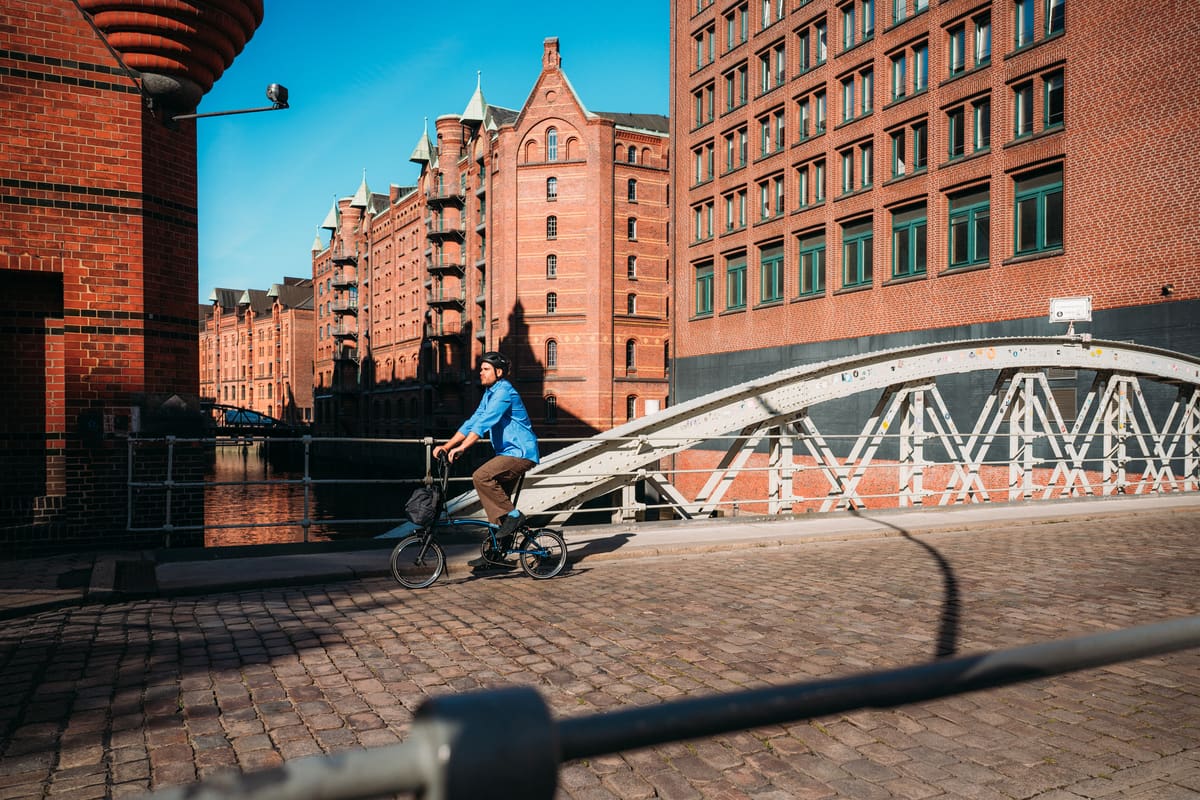
But, thanks to an InnovateUK grant, Brompton got the Money and launched their first e-bike in 2018. Despite this, retailers like ourselves could still sense an agitation – a sense that if Brompton really is engineering for change, it wasn’t quite there yet. Something about the bike still had to be changed. And, that change has come.
The MK6 frame: Architecture for the Solution
The development of e-Motiq did not happen in isolation. It arrived at the exact moment Brompton resolved another long-standing internal struggle: gearing. This helps frame the problem because the problem was, well… the frame. For decades Brompton used the same three-speed Sturmey-Archer hub you’ll find on heavy Dutch city bikes. This hub was designed to accelerate heavy Dutch klunkers, but that was hardly Brompton’s problem. A Brompton’s small wheels mean that zippy acceleration is native. So, a Dutch hub on a Brompton has always been a mismatch (even though it’s still used on the Brompton A-Line to save a few bucks).
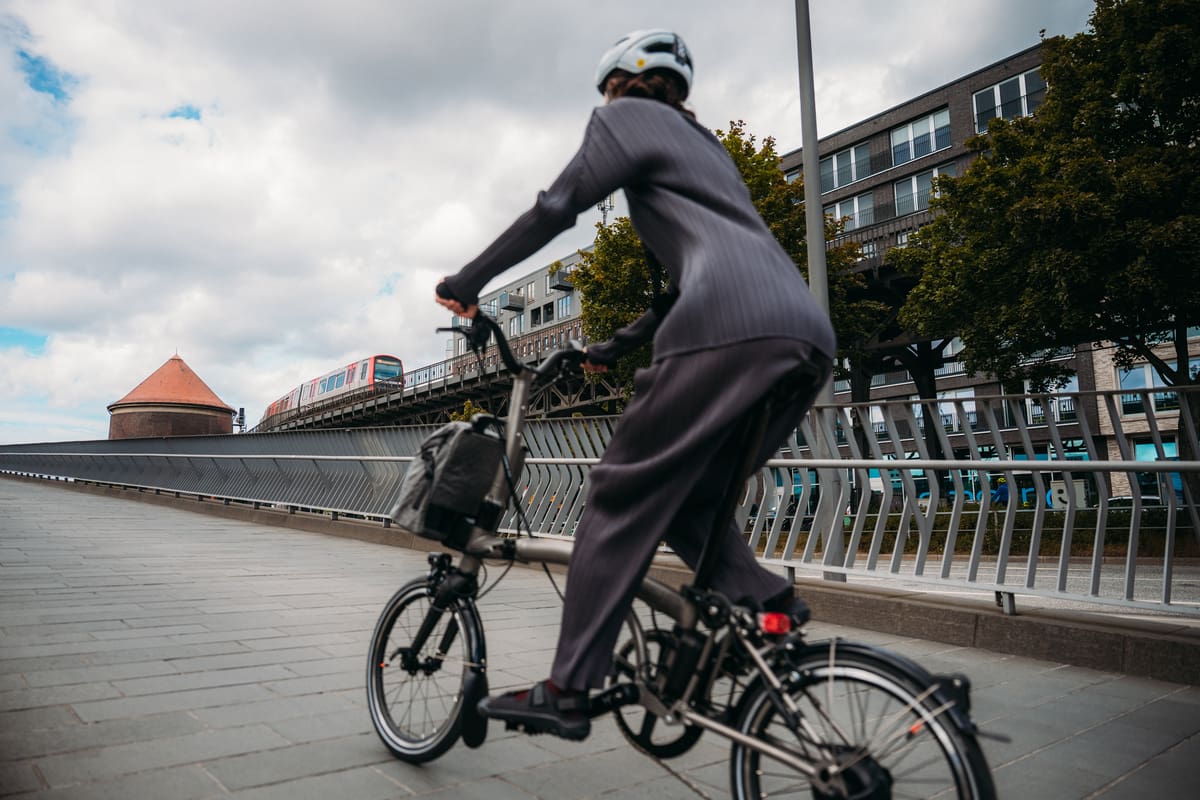
So, in 2006 – around the same time the Brompton Electric bike began it’s development – Brompton developed a solution: the six-speed bike. This bike used a super wide range three-speed that Brompton developed with Sturmey-Archer combined with a two-speed shifter to help fill in the gaps. It was clever, elegant, and endlessly capable; but it also meant the rider frequently had to do a bit of mental math and a lot off fiddling. If the six-speed wasn’t perfect, neither was the two-speed bike they launched at the same time. In essence, this was a pared-down six-speed bike without the three-speed hub. As a minimalist tool for the last-mile city cyclist, this bike was close to Brompton’s mission to engineer change. But, as a stand-alone system it didn’t work. It lacked range: it climbed poorly and riders spun out at speed.

Epochal Shifts
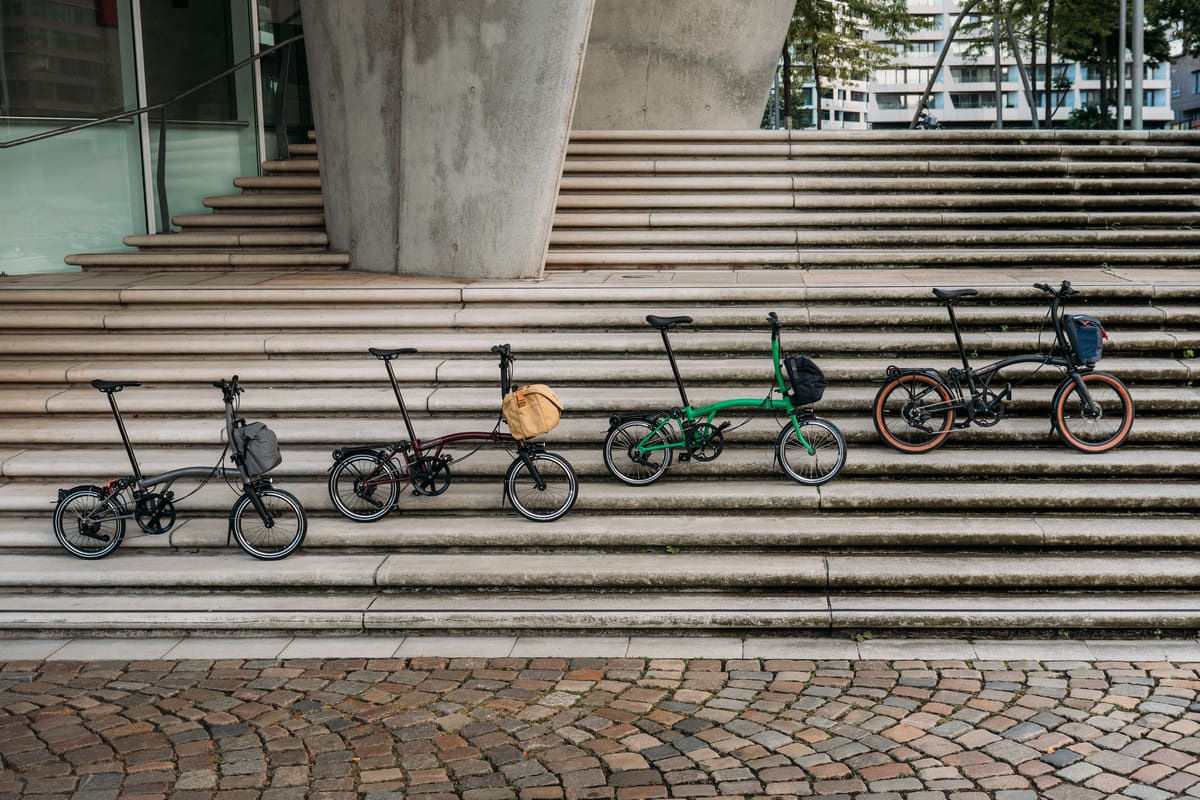
Then, in 2025 – an epochal year for Brompton and also their 50th Anniversary – Brompton launched a new rear frame across all of its bike models, and with it a four and twelve-speed system that offered the perfect range of gears for the city cyclist. The twelve speed used the same internal hub as the older six speed, but with a four speed system in tow. Unlike the old two speed system, the four speed was enough to finally operate as a stand-alone system. And, the best application for this new four speed system was the Brompton Electric bike.
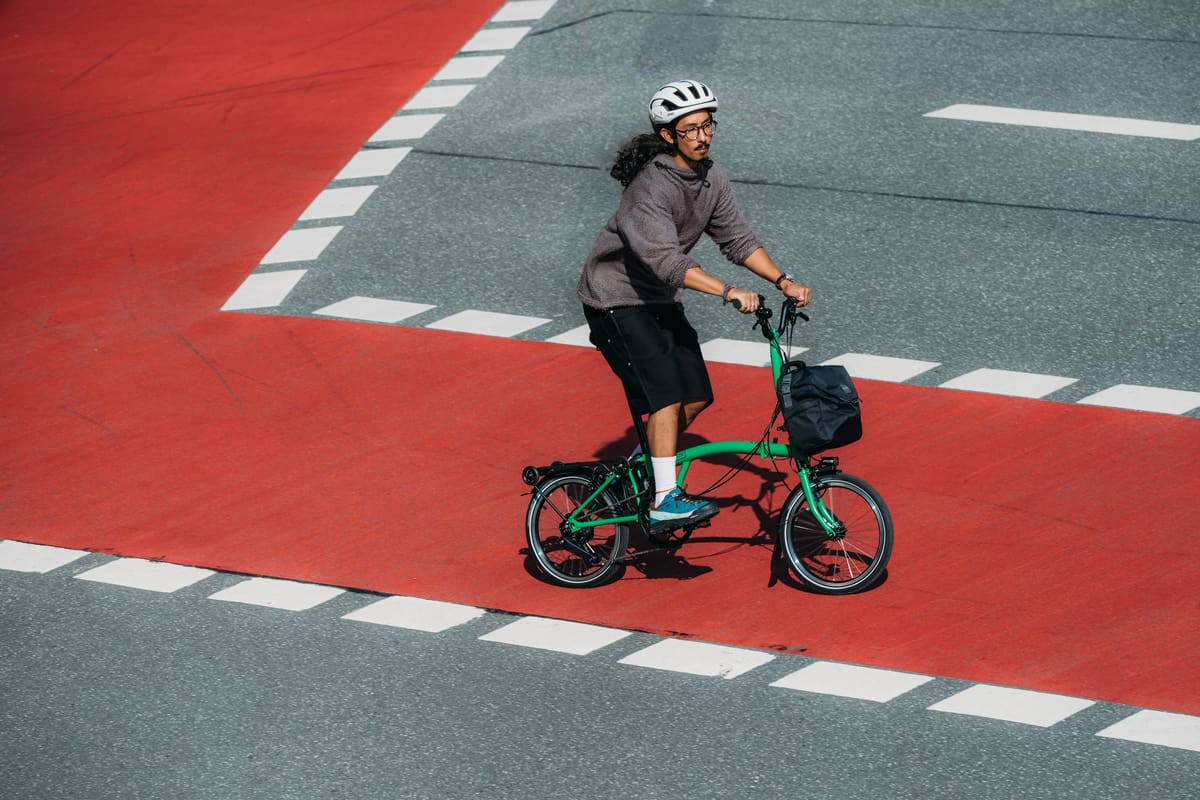
Why? That’s because the electric assist automatically adds more accelerative oomph no matter what gear you’re in. Anyone who bought a previous generation 12-speed Brompton Electric bike knows this. The motor makes a large part of your shifting redundant. With the four speed the perfect motor meets the perfect gears.
The Big Push
If the Brompton e-bike has been a passion project of Will Butler-Adams to engineer change, it had to pull a lot of things together to get there. And, as we’ve seen, many other things also had to get pulled together at the same time, including gearing and then finally the frame itself. In his book, Will Butler Adams states that a company needs to pull rather than push. And, it’s true. A good idea isn’t something you can sell before it’s even made. It needs to be tested and then it needs to be scaled. It takes a while to pull together the MOTIQ; the Money, Organization, Time, Information, and Quality. Fair.
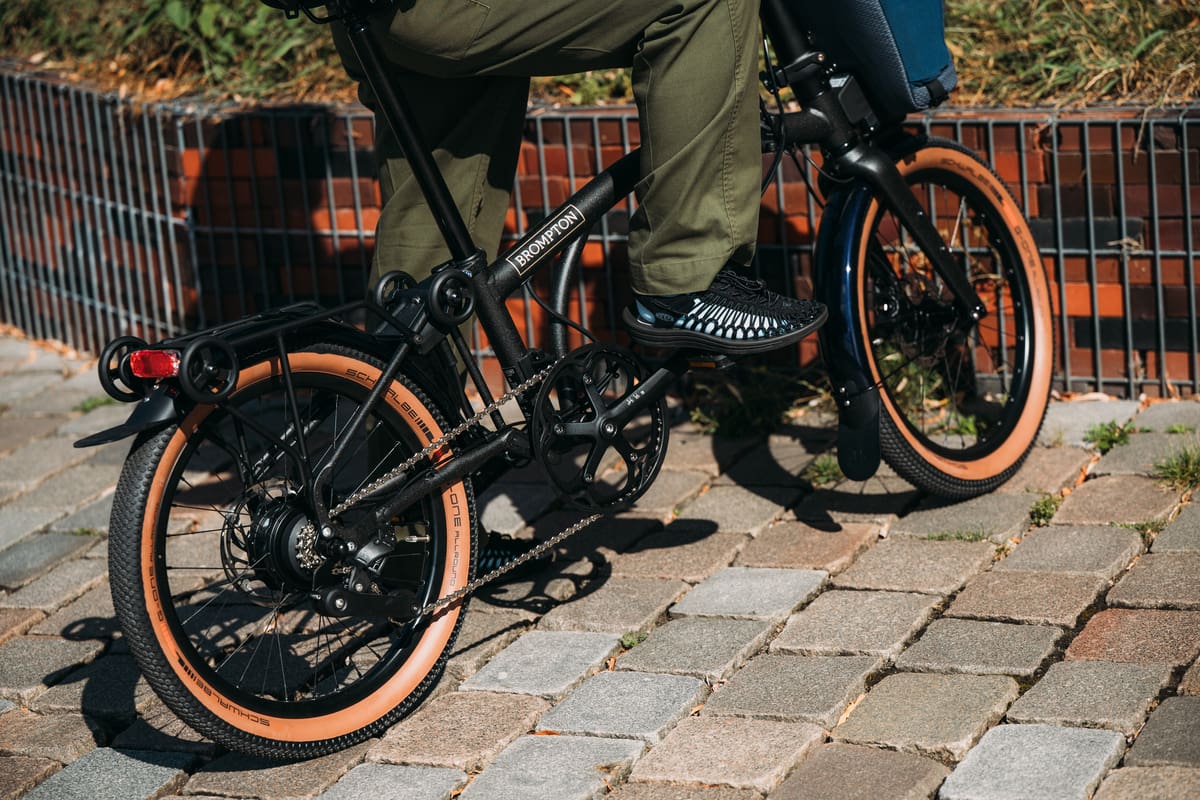
But, there is something about all this pulling together that might bring the possibility for a greater push. In the last two years, the changes on Brompton bikes have been epochal. We’ve seen ultra-lightweight T-Line bikes with four-speed drivetrains for cyclists who need the ultimate last mile tool. We’ve seen advancements like the G-Line, a bike that can commute through Toronto ravines on hard packed dirt as well as it can hop curbs downtown. Even the P-Line, which struggled for years to become itself, has arrived. And now, the e-Motiq motor. There is a sense of arrival after fifty long years of pulling things together. Just like our own story importing Bromptons and now developing Pedaal, it took some MOTIQ. And, that’s exciting, because from our very first meeting with Will Butler-Adams, our goal has also been to engineer change. It took a long time to pull together, but it feels like now we have the tools to push.

Next Steps
Got a question? We’d love to help! For quick questions, click the chat button during opening hours or shoot us an email at info@pedaal.com. Want to really drill down with some questions? Book an in-store or remote sales appointment by clicking here. Of course, we’re also a phone call away too! Just dial 416-972-1422, ask for Eric or Timm and we’d love to help!