
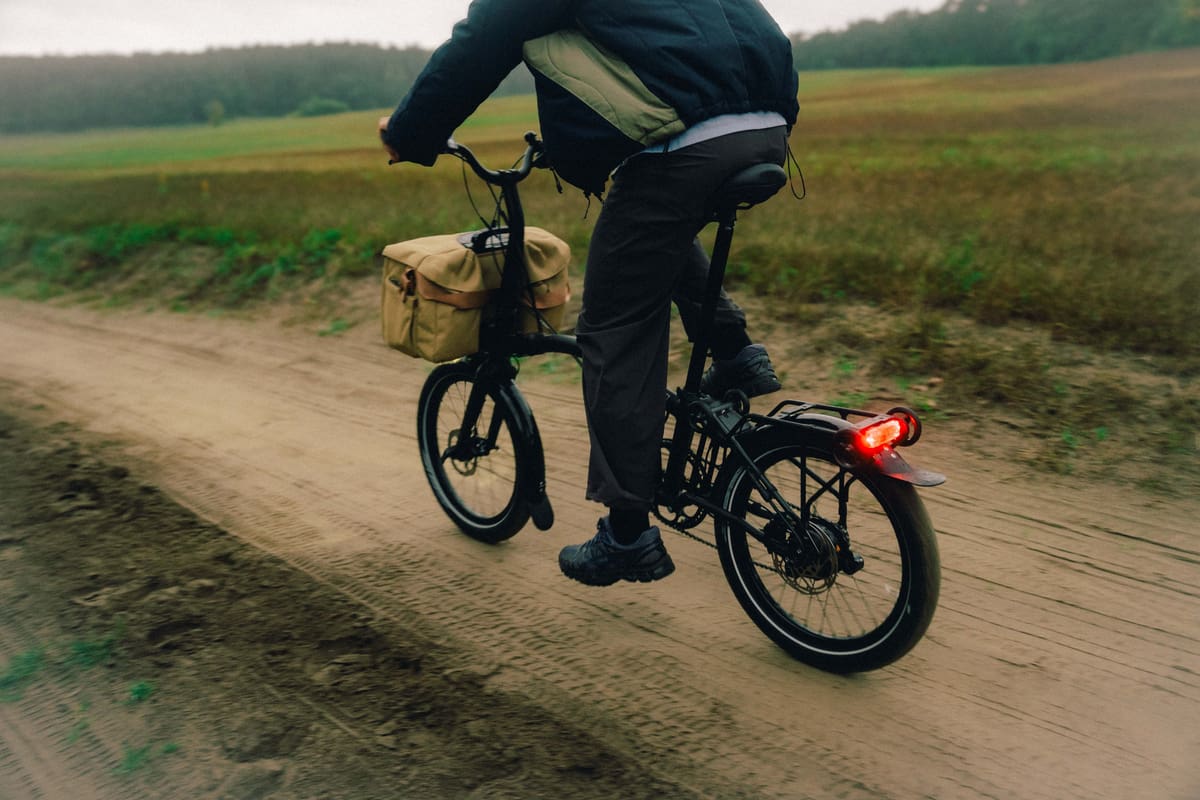
The G-Line arrived in 2025 and immediately became our second best-selling Brompton, right behind the dependable C-Line. The C-Line represents the classic Brompton formula: compact, light, quick to fold. But, the G-Line is different. It feels engineered for a more demanding urban reality, the kind where pavement breaks without warning and shortcuts turn into gravel. Bigger wheels steady the bike. Hydraulic brakes keep control when conditions shift. The geometry stays calm at speed. Its purpose is transportation. Its talent is that it also loves gravel.

What’s New?
The G-Line solves problem of the last mile. The G-Line Electric makes it disappear. If you live, work and play downtown, the majority of your travel isn’t distance. It is friction. Neither walking, driving or transit can effectively unlock it. A Brompton removes the friction. With the G-Line, a bike stops being a sport and becomes transport; the fastest way to connect your daily life. No other tool glues urban life together better than a bicycle. And, because urban life is a constant circulation of indoors and outdoors, a bike that tucks under your desk removes all remaining friction. The practicality is manifold, but so is the fun.
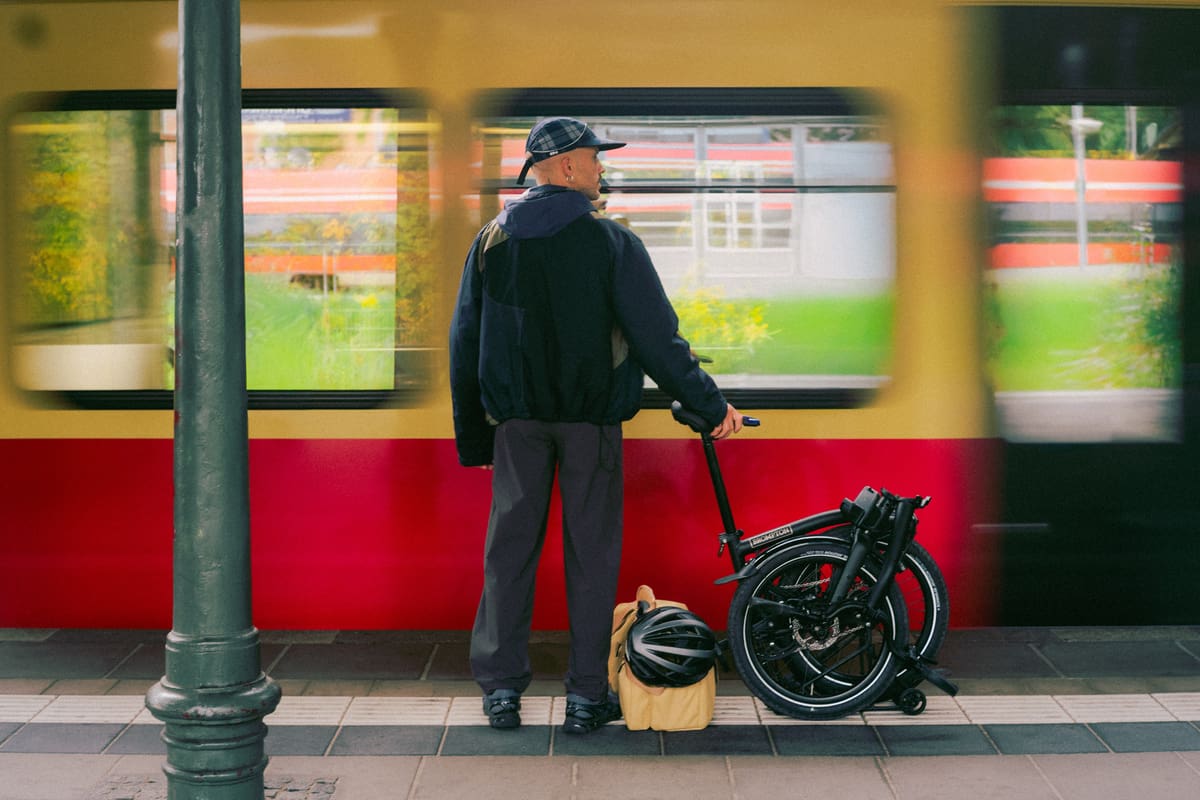
If the G-Line was made for North America, it feels like it was born for Canada. Unlike European cities, Canadian cities weave wilderness into the grid. Toronto’s ravines. Montreal’s Mount Royal. Calgary’s river valley. Vancouver’s Stanley Park. One minute you are in a bike lane, the next you are on hardpack or gravel. Frost heaves, utility cuts, construction detours, roots, and broken asphalt all show up without warning, sometimes in the same commute. The wider the tire, the smoother the commute. The funner the commute! But, unlike other bikes, the G-Line folds. It rolls into elevators and tucks under desks. It solves the Canadian equation: small living spaces, real theft concerns, and four unpredictable seasons.

Colours
The G-Line colour palette feels like something pulled from an Arc’teryx rack. It nods to streetwear and to the outdoors, which makes sense, because the G-Line, like a good technical jacket, performs in both environments. Traildust White has a subtle sparkle that evokes the chalked limestone of a rail trail or the pale gravel of Toronto’s Rosedale Ravine.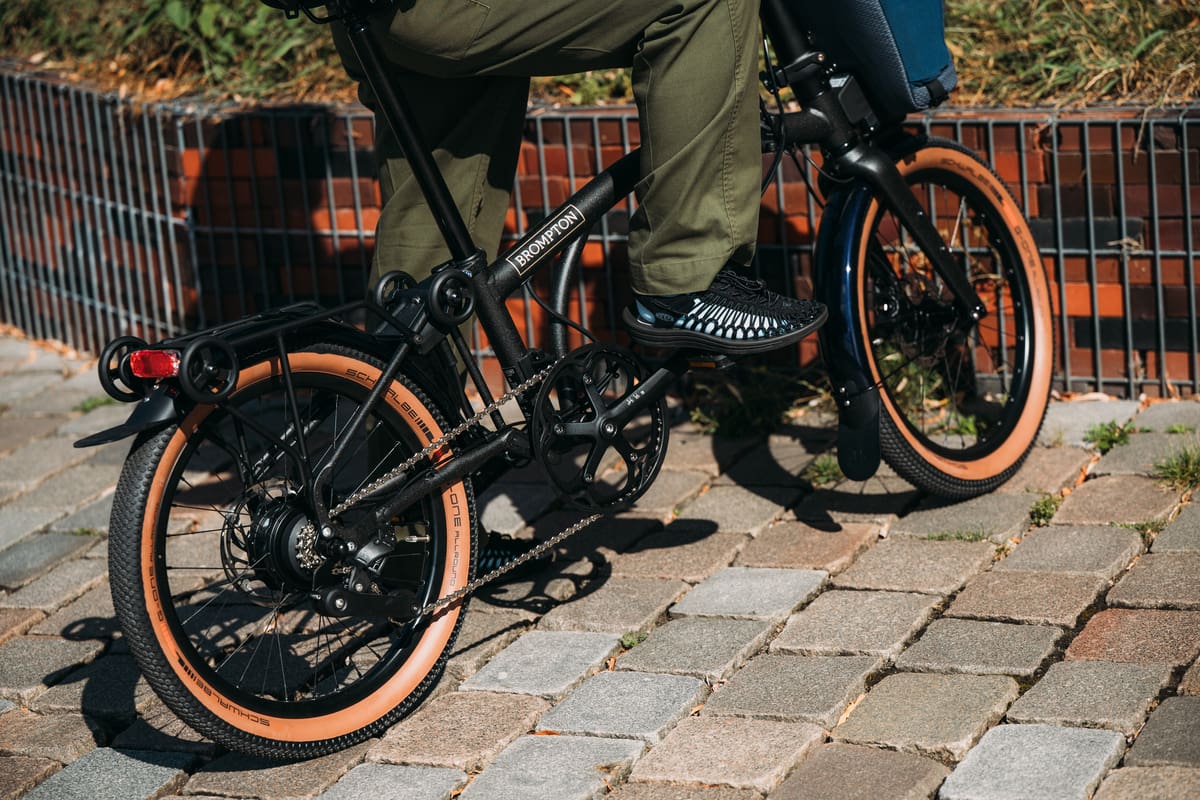
Like a Barbour jacket, the Forest Green colour blends into the surroundings, whether that means the Humber Valley’s urban forest or the singletrack out in Durham Forest. Sunset Orange recalls visibility and confidence, the visual language of trail markers, rain shells, and safety vests. And, the new Space Black completes the palette with metallic depth, reminiscent of a night sky on an overnight ride or the shimmer of city lights during a late run across town. Choose how you want it to blend in with trail, forest, or night sky, or make yourself stand out.
The E-Motiq
For 2026 the biggest update is singular, but massive. In 2026, the G-Line Electric launches Brompton’s new rear-hub e-Motiq system. Earlier electric Bromptons used a front hub motor. That worked on tiny wheels, but less so once speeds increased and more obstacles appeared. From an engineering point of view, a rear hub motor only makes sense. After all, the front wheel is for steering. The rear wheel is for propulsion. Put the motor in the front and the bike pulls. Put it in the back and it drives with you. But, it took Brompton a long time to pull the Money, Organization, Time, Information and Quality (MOTIQ) before they could design the push they wanted. Enter the e-Motiq.
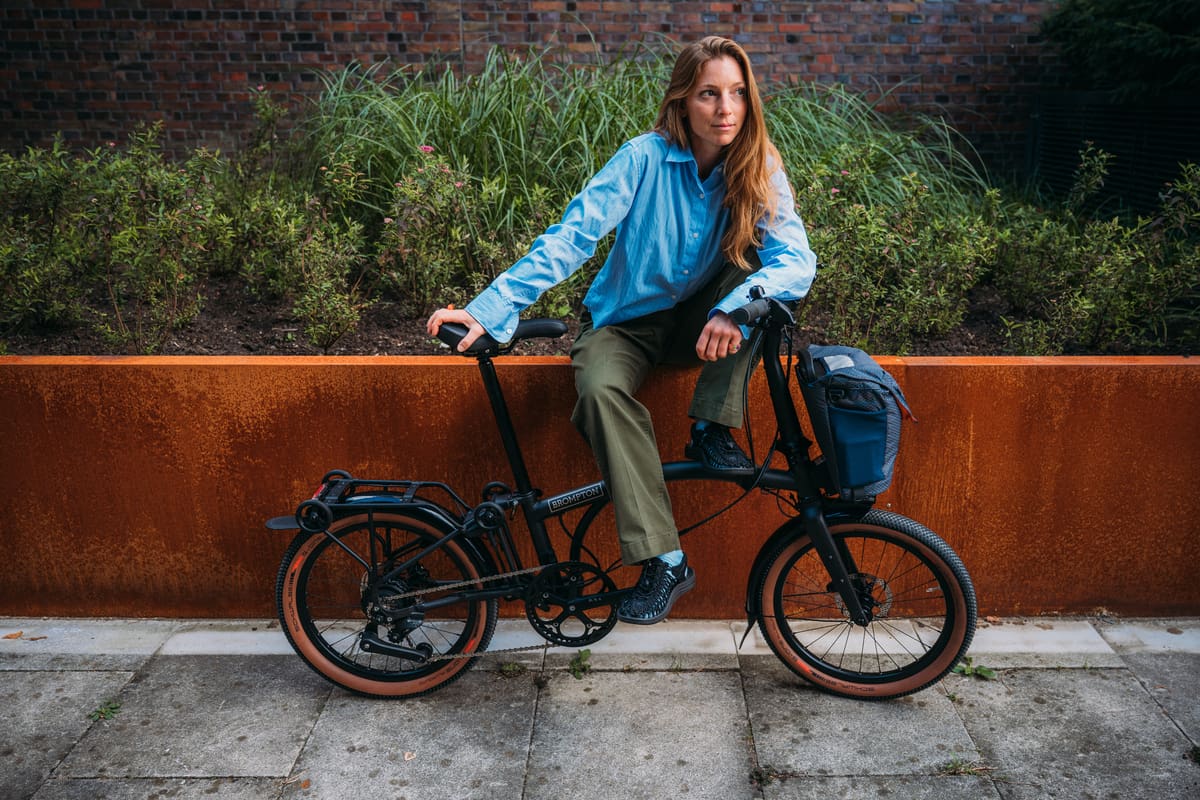
On the Electric G-Line, e-Motiq is tuned with more torque, and in the North American market it provides assist up to approximately 32 kilometres per hour. With larger 20-inch wheels and geometry designed for pavement, shortcuts, and the occasional gravel detour, the bike needed power that complemented handling. By placing the motor in the rear hub, the front wheel stays free and reactive. You steer. The motor follows.

Who is it for?
The assumption is often that a city bike should be smooth and predictable – like a heavy Dutch bike – while a “country bike” should handle rougher surfaces. In reality, the opposite is often true. In Canada, city riding introduces more obstacles than the countryside. Potholes appear without warning. Utility cuts in the pavement break the rhythm. You roll through construction detours, streetcar tracks, broken asphalt, puddles the size of ponds. Side paths and shortcuts often turn into gravel or hard packed dirt. Plus, as mentioned, Canadian cities uniquely fold wild space into their grids. A commute can shift from bike lane to a ravine trail in a few minutes.
The G-Line is built around that shift. Larger wheels and wider tires give the bike stability when surfaces change. The geometry stays calm at speed. The rider does not have to think about whether the route is “urban” or “recreational.” The bike handles both because the design problem is the same. Surfaces are unpredictable. The G-Line’s capability off pavement comes from solving the realities of pavement itself. Wired Magazine calls it “stupid amounts of fun.” It really is!
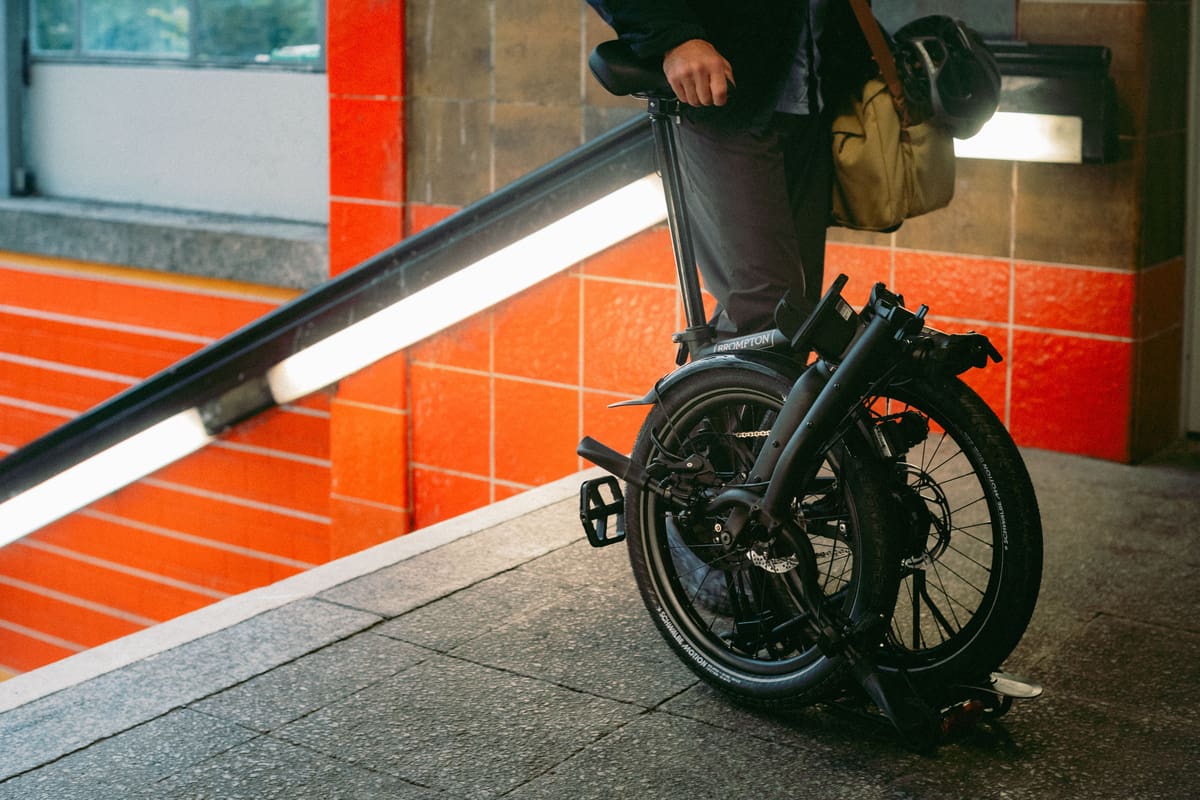
Where the G-Line separates itself from other capable bikes is not only in what it can ride over, but in what it can ride into. It folds and it goes indoors. It rolls into elevators, onto trains, into offices, and back home again without being locked outside. The recreational capacity is simply a result of designing a transportation tool that can handle the real city, not the idealized one. When you view the G-Line as transport first, it outcompetes cars, transit, and all other bikes – including Bike Share. It is faster to move, easier to store, and because it comes inside, it is always available.
How does it ride?
The G-Line Ride
The first ride makes one thing clear: this does not feel like a regular Brompton. The wider tires sit on the pavement with a grounded, confident stance. Steering is crisp and immediate, very much “point and shoot.” The larger wheels accelerate like the smaller wheeled Bromptons but hold a higher top speed. The sensation is not simply “a Brompton with bigger wheels.” It feels like an entirely different category of bike. Take it from Pier and Heather from Bromptoning, two Canadian Brompton bloggers who tested the bike here. Their opinion? The traditional Brompton is a business machine. The G-Line is a fun machine. But lordy, does it also mean business.
At moments it evokes the playfulness of a BMX. It’s the kind of bike that can easily hop a curb. But, it lacks the short wheelbase of a BMX; it feels planted. The G-Line stretches out to a length comparable to a modern mountain bike, which gives it stability at speed and a more athletic posture. But, it’s not a mountain bike either; the wheels are too small. If anything, it’s the most like a gravel bike – partly because a gravel bike offers the closest comparison to a bike that rides as well in the city as outside of it. But, a gravel bike doesn’t fold. You can’t take it inside; and outside it only gets stolen. Truth be told, the folding is the only place where the G-Line still feels like a Brompton. Otherwise, the ride is something entirely new.

The E-Motiq Ride
Then there’s the new e-Motiq G-Line. With e-Motiq, the motor provides the push and your brain stays in charge of the line.on terrain and assist level. You don’t have to manage the battery or think about efficiency. You ride, and the motor supports the effort. The rear motor introduces two behaviours that change how the bike feels in motion. Start Assist gives you the initial push when you begin pedaling and Adaptive Learning studies your cadence, acceleration, and riding patterns, and then tunes the assist curve to match you rather than forcing you to match the system. Learn more here.
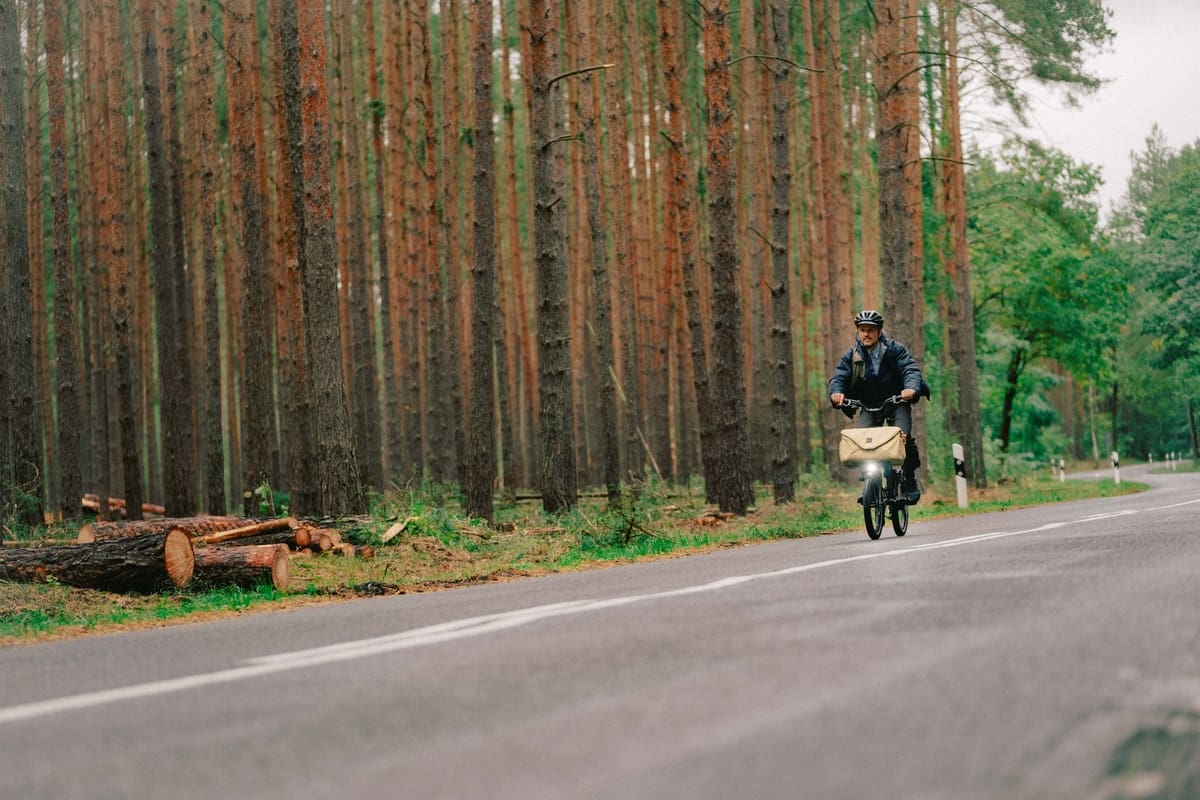
This is where the four-speed drivetrain makes sense. On a conventional bike you shift constantly to control cadence. On a pedelec that workload is shared. When torque spikes on a climb, the motor fills the missing gears. When the grade levels out, it fades into the background. The bike stays intuitive, even on changing terrain. The result is dependable real-world range: up to 90 kilometres on a single charge, depending on terrain and assist level. You don’t have to manage the battery or think about efficiency. You ride, and the motor supports the effort.

What you gain / What you give up
Choosing a G-Line or Electric G-Line expands what a smaller wheeled Brompton can do. The larger wheels and wider tires increase stability on uneven pavement and mixed surfaces. Yet, the G-Line keeps the folding convenience and indoor mobility that define a Brompton. The only thing you really give up is ease of carrying on stairs. Like all Bromptons, the G-Line folds cleanly and fits under your desks and rolls like a suitcase, but when you lift it, the extra size becomes noticeable. Riders with long, steep daily stair routines may prefer the lighter, smaller platform. But, we’ve already seen our customers choose the G-Line because the ride quality outweighs those moments. Stairs only take seconds. Consider it a short core workout before you sit all day to work.
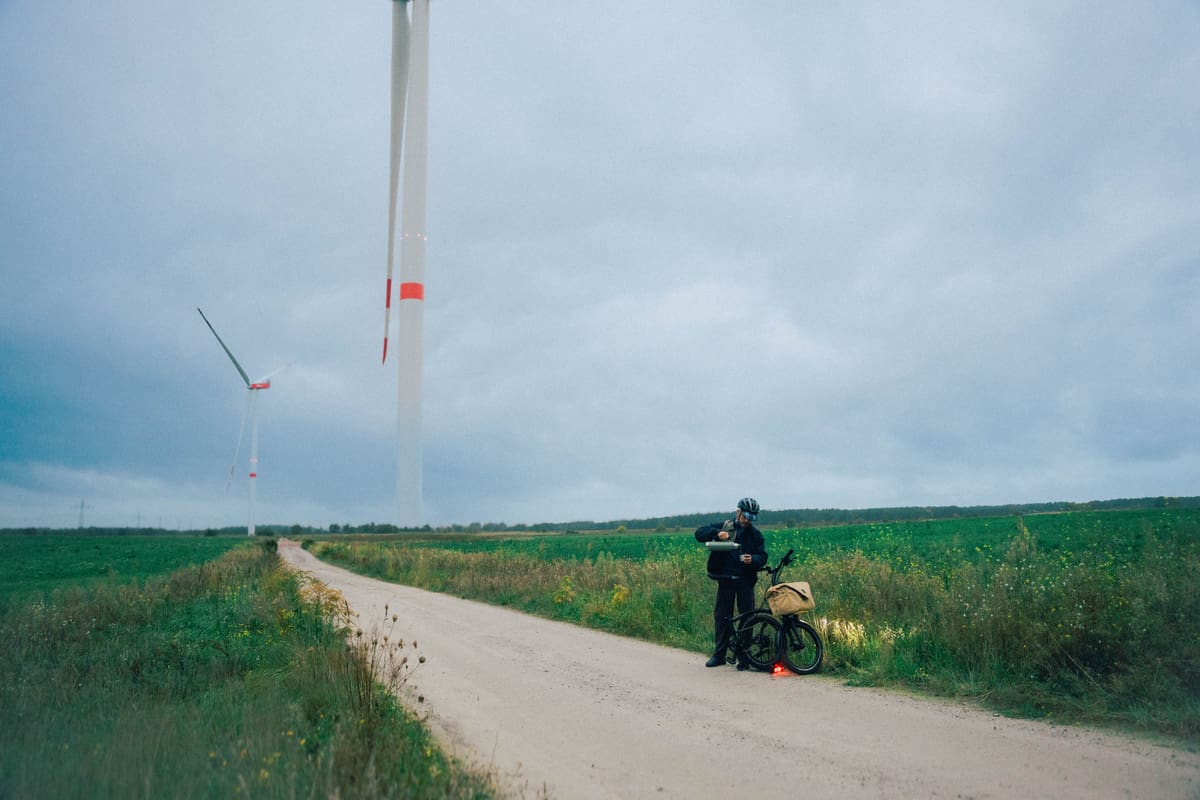
Brompton’s are great for flying to a new destination, and the G-Line is the ultimate adventure bike. But, this also introduces a new calculus. A 16 inch Brompton can fit into standard checked luggage or even overhead bins on larger aircraft. But, the G-Line will almost always go into oversize. Thus, if your travel involves exploring Paris or Amsterdam, the smaller platform remains ideal. But, if your trips involve riding between cities, the G-Line is a full-fledged touring bike. The larger wheels and wider tires make rough surfaces feel easier and faster, yet you still have the advantage of folding and checking the bike into a hotel or on the plane. So, if you’re a business or leisure traveller who wants frictionless check-ins, the smaller wheeled bike is perfect. But, if you’re planning to ride Ireland’s Wild Atlantic Way, the G-Line is ready to climb, sail and tuck into a pub.
Which Brompton G-Line to Choose?
Choose the G-Line if: You want the pure ride. And, you value agility, stability on mixed surfaces, and the freedom to fold and take the bike inside. You prefer human power, but want a bike that makes rough pavement, detours and gravel feel natural. You want the simplicity of an eight speed drivetrain with zero charging to think about. The G-Line is the most capable non-electric Brompton ever built. These bikes are in stock and available from Brompton now. Check the status or place a pre-order below.
Choose the G-Line e-Motiq if: You want the ride and the boost. You want to arrive fresh and unrumpled. You deal with headwinds, hills, heat, or longer daily mileage. The motor handles effort so you keep focus on the line. Start Assist launches from every stop. Adaptive Learning tunes the support to how you ride. Range is real world, up to about ninety kilometres depending on terrain and assist level. Choose this if you want the G-Line to erase distance and remove sweat from the equation. These bikes are in stock and available from Brompton now. Check the status or place a pre-order below.
Next Steps
Got a question? We’d love to help! For quick questions, click the chat button during opening hours or shoot us an email at info@pedaal.com. Want to really drill down with some questions? Book an in-store or remote sales appointment by clicking here. Of course, we’re also a phone call away too! Just dial 416-972-1422, ask for Eric or Timm and we’d love to help!
Questions about a Brompton? We can help!
Related Posts
Brompton P-Line 2026 Overview
The P-Line has existed in Brompton’s lineup for nearly two decades, but for most of that time it occupied an odd space — the misfit child in the Brompton family. The concept, first introduced in 2005 under the name Superlight, was straightforward: use titanium where lightness and ride comfort matter, keep steel where durability matters....
stay up to date
Stay in the Know. Join our Newsletter!
*By entering your email, you agree to our Terms & Conditions + Privacy Policy,
including receipt of emails. You can unsubscribe at any time.

Pedaal designated official Brompton Gold Dealer status - Read more