In 2021, Brompton renamed their steel-frame the C-Line, introduced a budget model called the A-Line, and re-named the “super-light” the P-Line. These lines replaced some rather complex naming conventions – like M6L or S2R-X – that kind of made people’s heads spin. These lines also helped segment each bike into different use-cases, helping buyers align their purchase according to their needs. In this article, we help draw the line between each Brompton line. What do we mean by that? Read our Brompton Buyers’ Guide and find out more!
Why Brompton is the Best
To begin, we feel compelled to remind the reader why Brompton is the best. And, by “the best,” we mean a bike fits into your life so frictionlessly that it almost boggles the mind. Ultimately, this will come down to the numbers, because a Brompton “best-ness” is, in fact, completely measurable. A folding bike, after all, is only up to the measure if it folds small, unfolds big, and transfers between these states quickly and easily. Above all, this measurability is a matter of use-case. A small folding bike is easier to carry when folded. A long wheelbase means that the bike plants a stable footprint. And, a bike that unfolds and folds easily only makes sense.
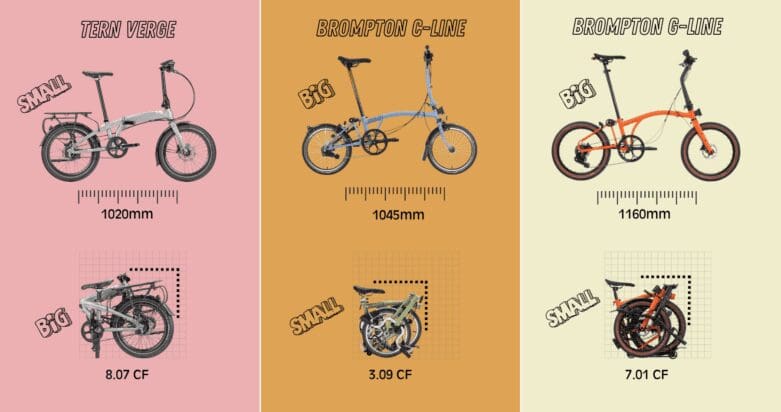
But, herein lies a paradox! (You can read more about this here). A bike that folds small will most likely unfold to a short and twitchy wheelbase. A bike that unfolds to a long wheelbase will probably fold to an uncarrieable size. Bikes like Dahon or Tern unfold small and fold up big, the exact opposite of what a folding bike is supposed to do. Brompton, through obsessive engineering and stubborn persistence, are the only company who make a bike that unfolds longer than most regular bikes while folding to a teensy tiny size. And, it’s a cinch to fold; you can learn how in under 5 minutes.

The Brompton G-Line
The G-Line might be the most exciting bike Brompton has ever produced. The customers who have tested it have stated that it rides nothing like the original Brompton, yet it is still recognizably a Brompton in terms of its fold. The difference comes down to use-case. The original use-case of the 16″ wheeled Brompton bike was for London train commuters.

The original Brompton was designed to link the “last mile” from home to train station, fold up for the journey, and then unfold for the “last mile” from train station to work. Once at work it could be folded up, and this solved the perpetual problem of on-street bicycle theft. But, all of this comes with a “bonus level.” A Brompton is great in the city but also a great bike to pack on a plane or camper van. No bike travels like a Brompton.

Intra-City versus Inter-City
Here is where two terms might help: intra-city and inter-city. The original smaller wheeled Brompton was always meant to be an intra-city bike. It was designed to efficiently connect all the “last miles” that make up city living; all the distances that are far too close to drive and still too far too walk. And, no other bike offers the same capability for intra-city travel elsewhere. Take it on the train and explore Montreal for the weekend. Take it on a plane and gallery hop around Paris. But then, Brompton began to notice that people were riding their original Bromptons the extra-mile – on gravel roads outside of the city. Some even loaded up camping gear and went on multi-day tours between cities. The G-Line is Brompton’s answer to this customer; a perfect intra-city bike and a perfect inter-city bike. It’s hard to imagine what the G-Line can’t do.
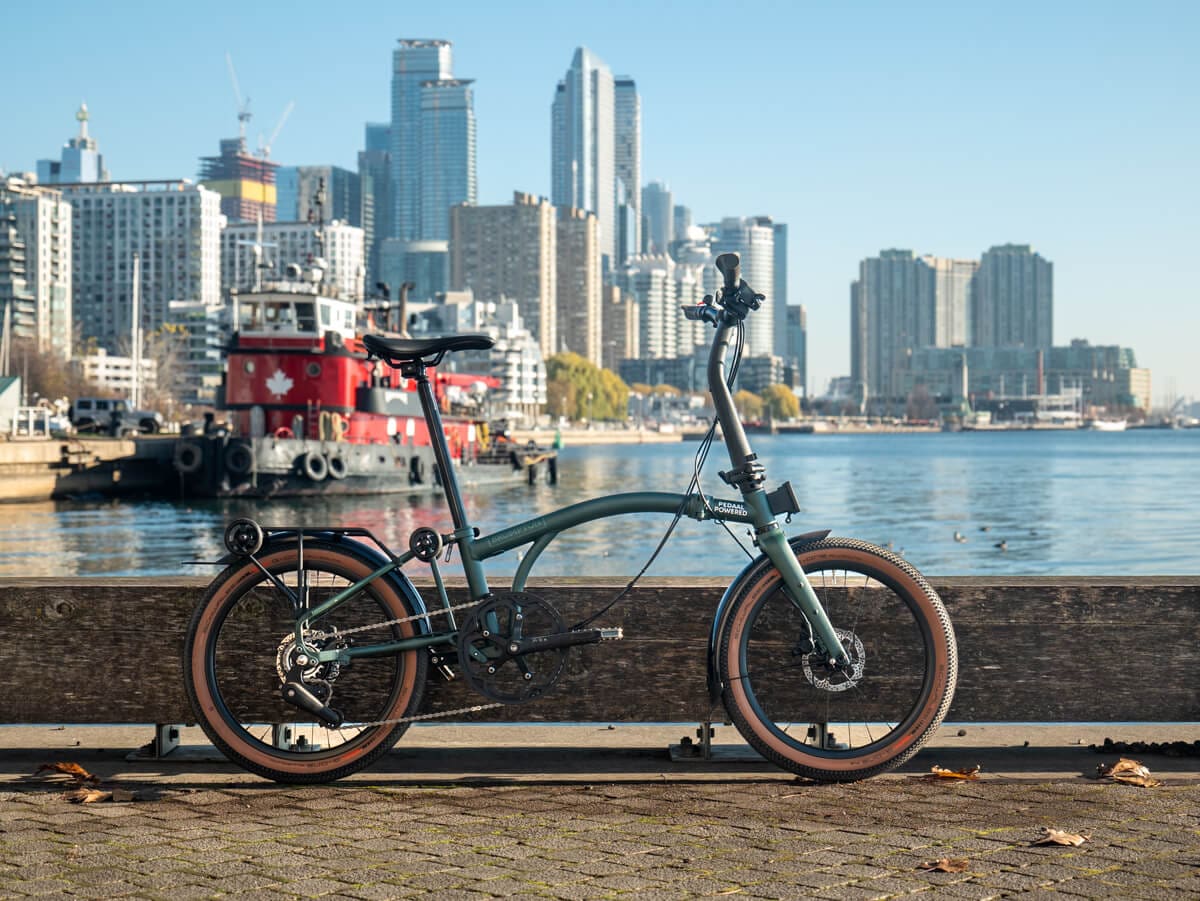
There are at least two reasons why the G-Line is such a great intercity and intracity bike. First, the narrow tires on the original Brompton really aren’t great on gravel or hard-pack dirt (even if Brompton users were trying to prove otherwise). Second, a larger diameter wheel is way more efficient for longer, sustained rides. In fact, the G-Line’s 20″ wheels are arguably better than the 16″ wheels for city riding. The bigger diameter means the wheels roll easily over potholes and streetcar tracks. And, the wider tires are way more stable – and they feel more stable too.

The only strike against the G-Line? It folds bigger than the original 16″ wheeled Brompton. Nonetheless, the question is does this larger size feel unmanageable? And, it really doesn’t. The G-Line is close in weight to a Brompton C-Line, it features the same easy-to-use “rolling mode,” and it takes little room in your cubby at work or on a crowded commuter train. The only real strike against the G-Line is air travel. Whereas the regular 16″ wheeled Bromptons can actually be carried onto a plane, the G-Line is always checked baggage, and sometimes considered oversize.
The Brompton C-Line
So, who is buying the original 16″ wheeled bikes? The answer is pretty easy. For the most part, the buyer of the original 16″ wheeled bikes are an intracity rider. These are riders who use their Brompton to link all the “last miles” that make up city life. And then there is the bonus level. The same person who commutes one day in Toronto might take their Brompton the next day to Boston on a business trip. They might even be doing a multi-day Bed & Breakfast tours on the paved bike highways of Holland. The new 12-speed drivetrain found on the C-Line really opens up this bonus level. And sure, the original 16″ wheeled bikes might not have the same off-road capacity as the G-Line, but if you’re sticking to concrete, there’s nothing the new 12-speed can’t do.
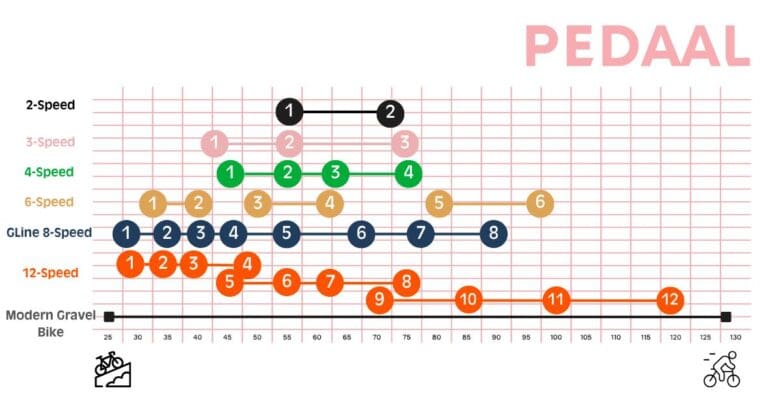
It’s easy to argue that the C-Line is Brompton’s original bike. And, in 2025, the C-Line has undergone a radical transformation. In terms of its parts and frame, the 2025 C-Line represents a new generation in forward compatibility. Like all previous C-Lines, the frame is still constructed of lightweight steel, but the new 4-speed and 12-speed parts will not fit on pre-2025 frames. We believe these new gear systems are worth the wait. Without going into too much math, the chart above compares all Brompton gear systems to a modern wide-range 12-speed gravel bike. The lower the gears number, the more you can climb hills. The higher the gears number, the faster the bike is when the wind is at your back. And, the more gears you have in between means you always have a gear that feels right when the terrain or wind shifts slightly.

The new 4-speed C-Line replaces the older 2-speed C-Line, which was never a great seller. The older 2-speed system was lightweight and minimalist, but in all respects it was a one-speed bike. Most people who bought the 2-speed found the difference between the gears so negligible that the added complexity felt redundant. The new 4-speed maintains the lightweight minimalism, but the wider climbing gear and narrower speed gears make the bike far more practical. And, the new 12-speed system, while a touch heavier, offers a gear range that matches a modern hybrid bike. If your commute is longer – and/or has bigger hills – then the 12-speed is your bike. Or, if you want a bike that can tackle the Montmartre hill in Paris, or a windy all-day ride on a Dutch bicycle freeway, then the 12-speed is your ticket to explore!

The Brompton T-Line
What would be the perfect folding bike? Well, so far we know that it would have to follow the Brompton design. It would have to fold up small and unfold big. It would have to fold and unfold quickly and easily. But, what if it was lighter? And, what if the ride quality was enhanced? What if it transferred more of your power into movement? And, what if it absorbed all the high frequency vibration that can exhaust you on a longer ride on uneven terrain? Enter the T-Line!
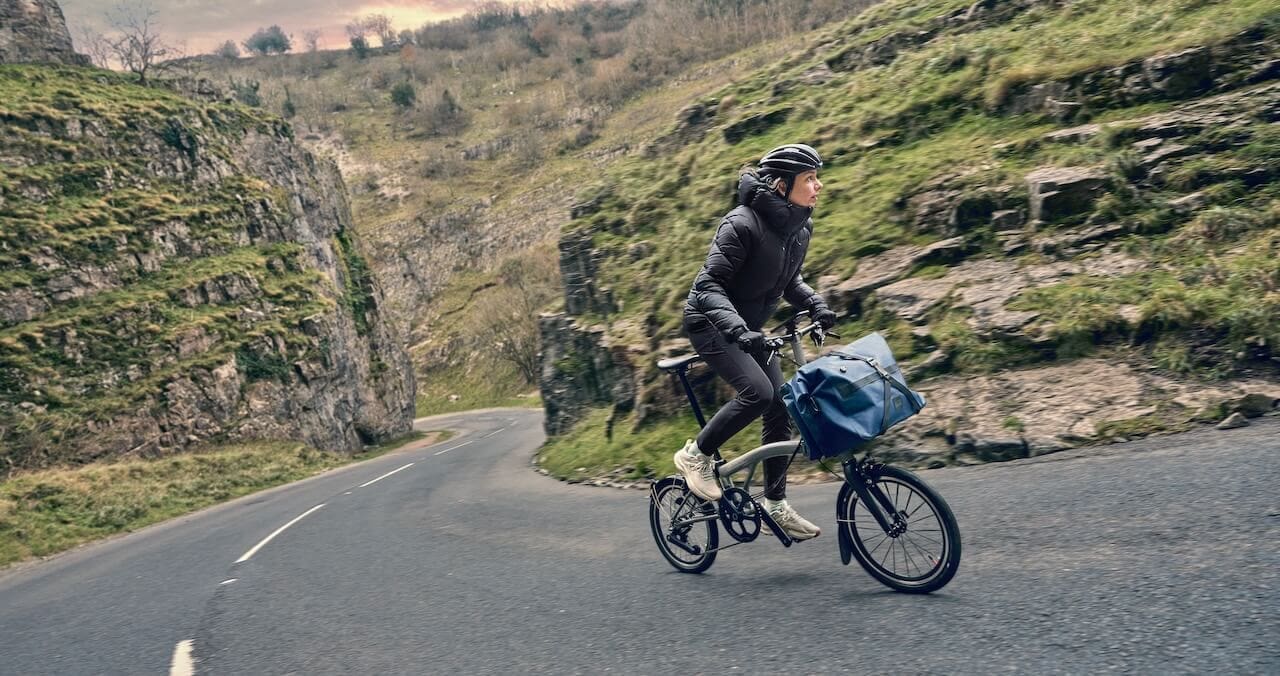
The T-Line answers these questions. At only 17.5lb (for the 4-speed) the T-Line is a full 10lb lighter than the C-Line. That’s quite an accomplishment! And, there are many use-cases that genuinely require a lighter bike. If you live in a walk-up condo with no elevator, the T-Line is the answer. It’s so light that you honestly barely notice it.
The T-Line is light because it uses a titanium frame and a lot of carbon fiber parts. The T-Line took Brompton on a 300km journey north to Sheffield where they joined forces with CW Fletcher, one of the most advanced titanium manufacturers in the world. Titanium is light, but it’s enormously complicated to work with; requiring highly skilled welders welding in a zero oxygen environment. But, what titanium gives back is not just a light bike, but a remarkably stiff bike that also soaks up shock. It’s hard to find a frame material that absorbs shock and transfers pedalling energy into efficient motion; this is why titanium is a wonder-material.

That makes the T-Line the perfect bike for anyone who wants to do longer rides. The lightweight frame moves quickly, the power transfer is sharp and crisp, and the bike reduces fatigue by soaking up bumps. Plus, if you suddenly hit a long flight of stairs, it’s a cinch to carry.
The Brompton P-Line
The P-Line was first launched in 2005 as the “Superlight” model. The Superlight hung around until 2021 when it was relaunched as the “P-Line.” The P-Line featured a brand new frame design made for Brompton’s new 4-speed and 12-speed system. This frame, called the MK6, became the template for the 4-speed and 12-speed T-Line (launched in 2022), and the newly revamped C-Line 4-speed and 12-speed (launched in 2025).
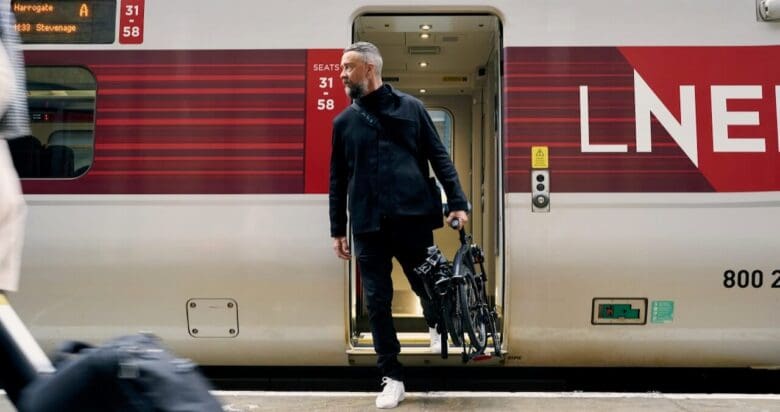
The P-Line sits squarely between the C-Line and the T-Line in terms of materials, weight and cost. If we were comparing the 12-speed bikes, the C-Line would weigh in at 26.9lb, the P-Line at 23.5lb and the T-Line at 17.5lb. That makes the P-Line 15% lighter than the C-Line, the T-Line 23% lighter than the P-Line, and the T-Line 35% lighter than the C-Line. Once again, the primary issue here is the carrying weight of the bike when folded. If you have long sets of stairs, whether at commuter train stations, the office or home, a lighter bike will always make the journey more pleasant.

The 2026 P-Line arrives with a full material refresh, and it shows. The main frame remains steel for durability and stability. Around that core, Brompton has rebuilt the bike with a smarter mix of lightweight materials. The new carbon fork cuts weight and sharpens steering feel. The updated alloy stem and alloy seatpost reduce flex and deliver a more direct ride. And the titanium rear triangle continues to provide the smooth, quiet compliance that has always defined the P-Line.
The Brompton Electrics
The Brompton Electric has entered a completely new era. For 2026 Brompton has retired the older front-hub motor and introduced e-Motiq, a rear-drive system designed from the ground up for the Brompton platform. It is the first time Brompton has been able to build an electric system around the bike rather than adapt the bike around the motor. The result is a quieter, smoother and far more natural ride that benefits both city commuters and long-distance recreational riders.
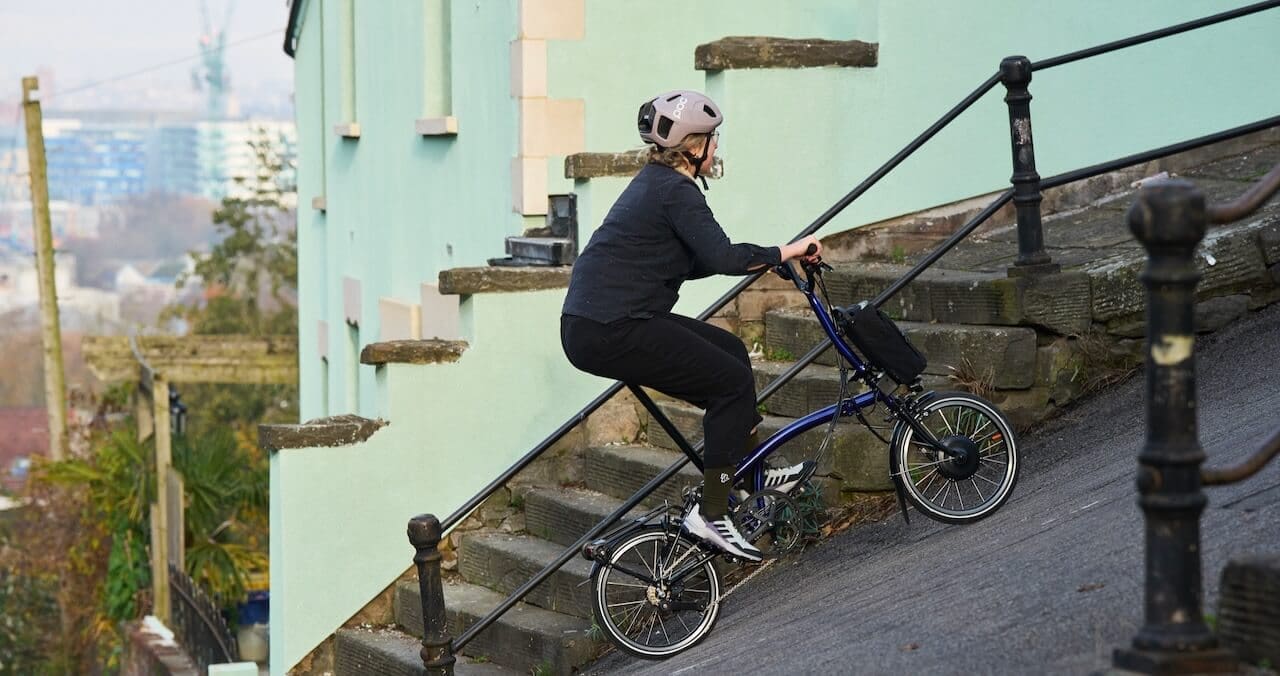
Some cyclists still insist that e-bikes are “cheating,” but a city bike is a transportation tool. The goal is to arrive on time and arrive dry, not to show up at work needing a towel and a wardrobe change. e-Motiq leans into that logic. It removes the friction that keeps people from riding. Hills soften, distances contract and travel time becomes predictable. And because it is a Brompton, the entire system still folds at the door so the bike comes with you.

The e-Motiq is a full torque-sensing pedelec. The motor reads pedalling torque, cadence and wheel speed, then adjusts power from moment to moment. On a climb, assistance ramps up. On the flats, it fades until the motor disappears into the background. Riders choose from three assist levels. The lowest setting delivers a modest 30 percent boost, while the highest offers up to a dynamic 70 percent assist that makes steep hills feel casual.
In Conclusion
We hope our walk through the various Brompton lines helps offer a Buyers Guide to purchasing a Brompton. Of course, it’s also possible that it opens up even more questions, in which case we’d love to help out! If you’d like to book a remote or in-store sales appointment, you’ll get one of our experts to answer any question you might have. We believe that a Brompton can change the way you commute or explore new places. We’d love to hear from you!