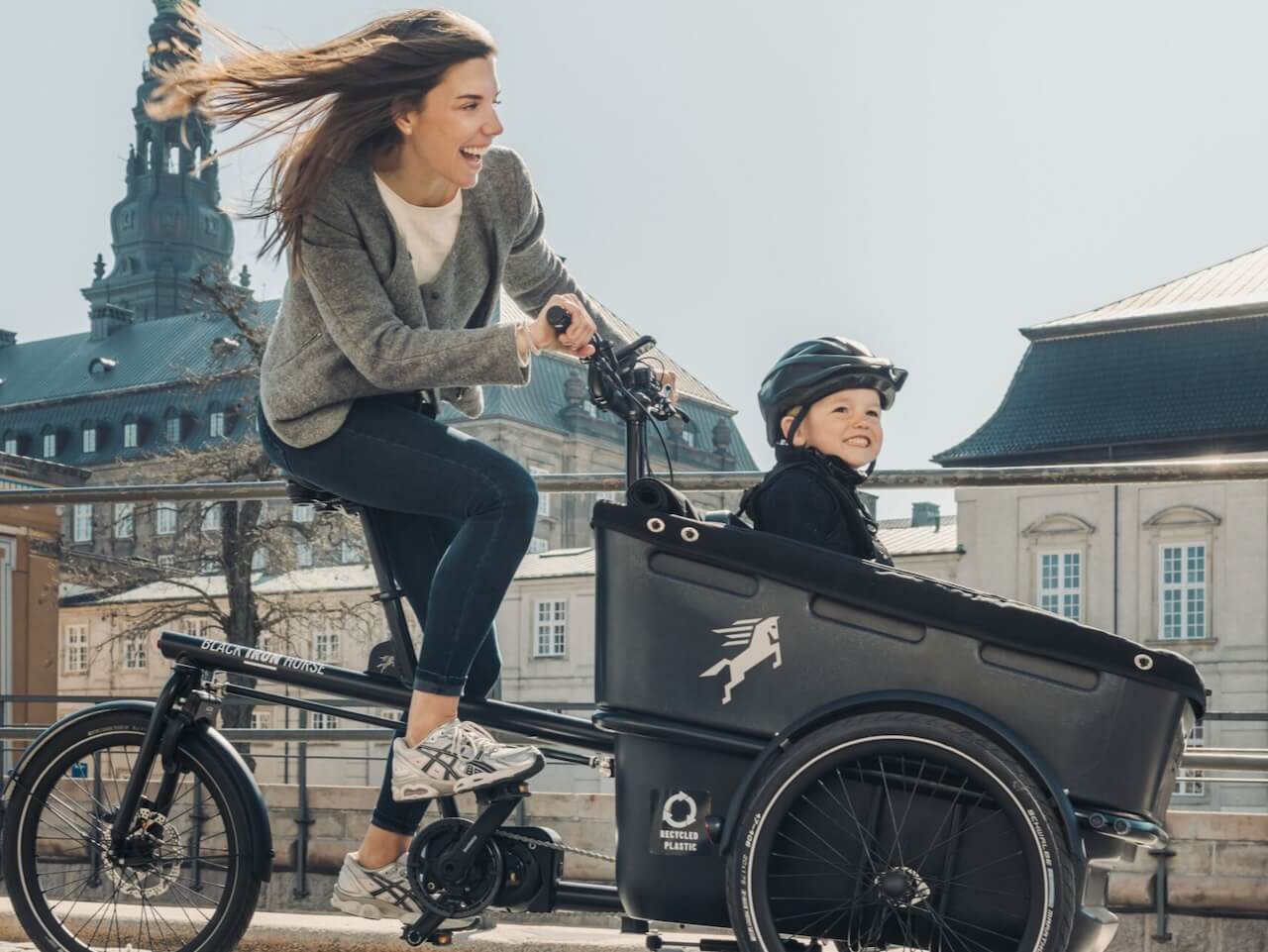
We all know that glorious feeling of pedalling once and coasting twice as long. That’s the topic of today’s blog. Transportation, when properly matched to distance, offers double returns. Transportation has always obeyed the pleasure principle. That’s right, this blog is about the unconscious.
Your Car Is Eating Your Goals
According to research a majority of Canadians spend a surprising amount of time thinking about change, even if they do not act on it. Health and finances sit at the top of most goal lists. Yet how we move through the city underwrites both. If driving is the default, the costs appear month after month through fuel, insurance, maintenance, and parking. It also shows up in your temper, blood pressure, and overall life satisfaction. Time lost in the car is time lost to the gym. And, money lost to the car is also money lost to your leisure time.
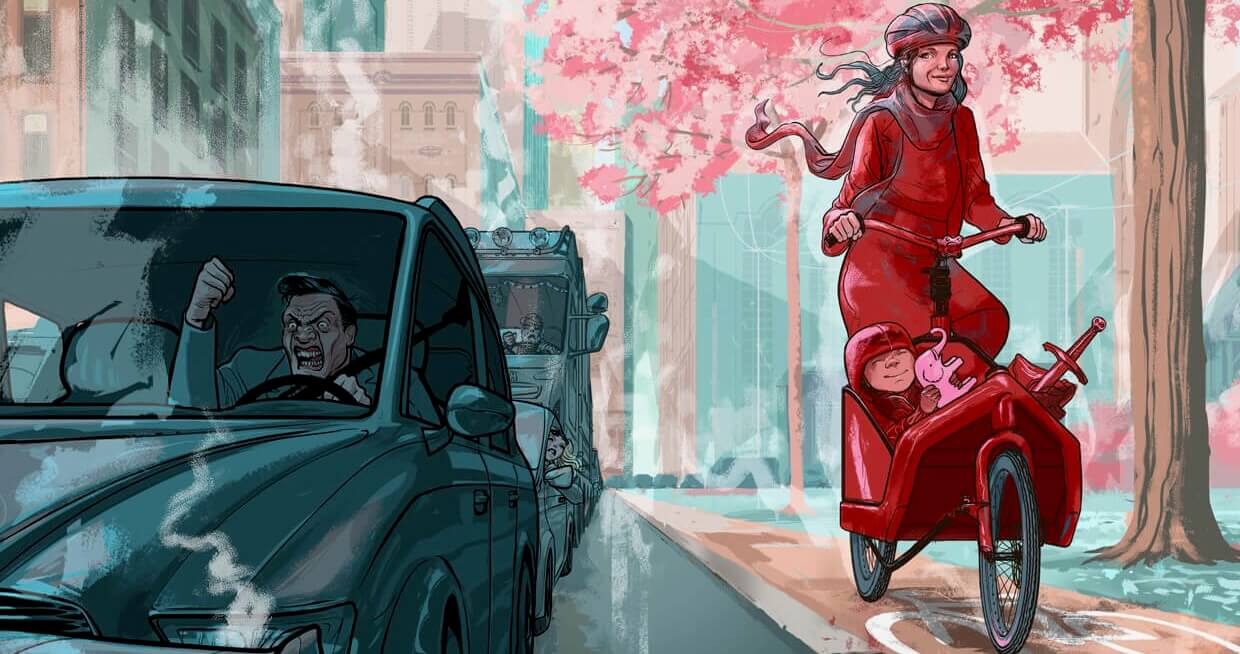
But, it needs to be said that we’re not here to diss the car. Cyclists often get stereotyped into some sort of “War on the Car” attitude, which is hardly true. Most of our customers own a car but mostly ride a bike. Our argument is: we think you should too. Truth is, we love driving, just not in the city. In our vision, a car does its best with a great soundtrack, a sunset, greasy fast food, and that unquenchable feeling of adventure. That’s what we believe a bicycle can not only defend, but can help enable.
Inherited Sprawl
Canadians appear to default to driving, whether they want to or not. Despite being expensive and frustrating, the automobile has been – until recently – culturally untouchable, treated as the default set of wheels for modern life. The question is: why?
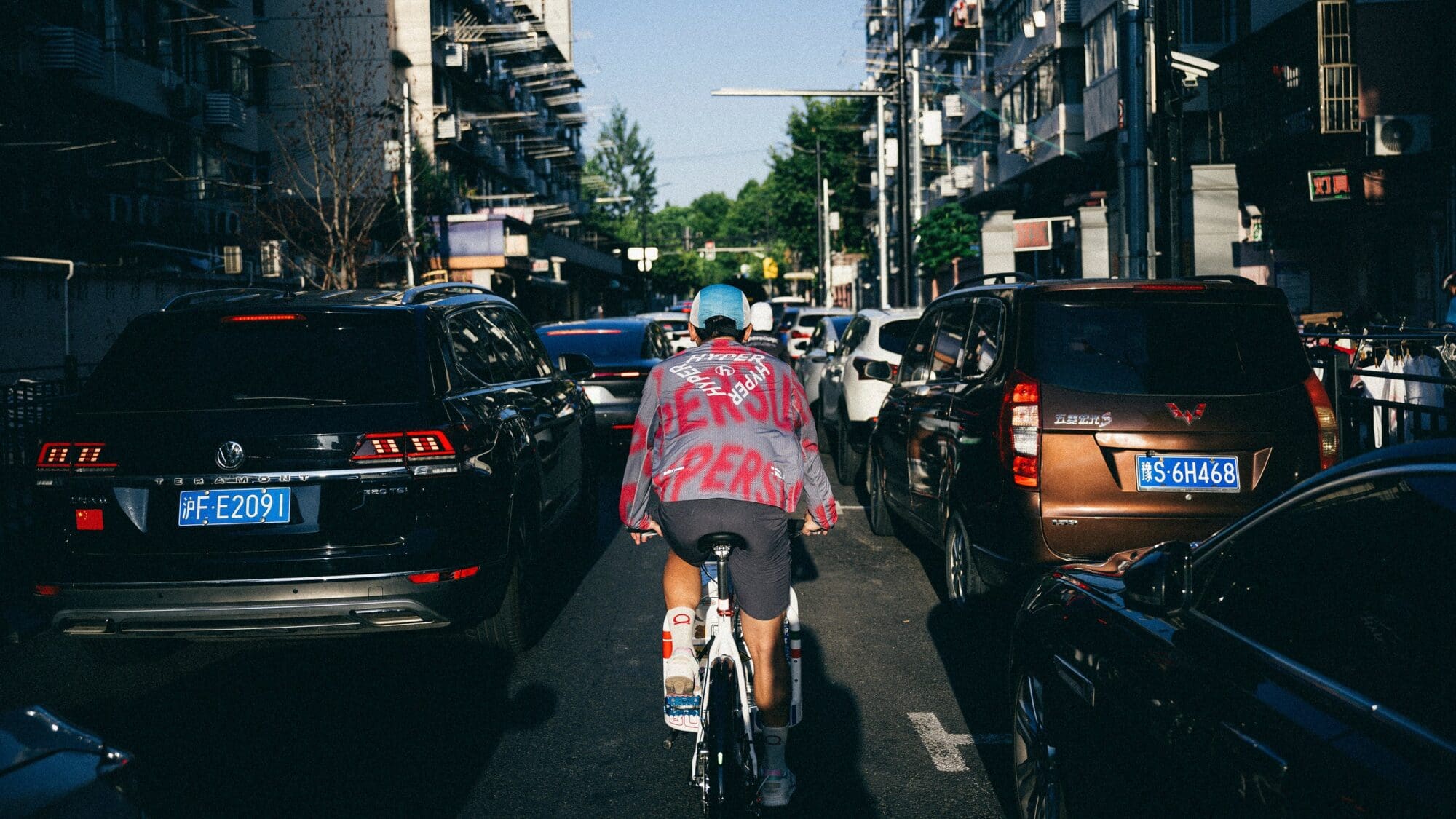
At Pedaal, we add bicycles to people’s transportation toolkits every day, and the answer we keep encountering is habit. In North America, that habit was shaped by the suburban experiment. This is a sprawling continent, and – after the railroads – the car became the primary instrument for inhabiting it. And so, cities sprawled outward and with that, normal everyday life spread far, far apart. And, along with that came isolation, alienation, and worse of all: boredom.
We’re Not Meant to Live This Far Apart
Luckily we humans carry older rhythms. There is an ancient, circadian pulse that puts cracks into the fantasy of this North American unconscious. Urban theorists and socio-psychological research have long argued that we thrive on proximity, frequent face-to-face encounters, and daily life that fits within the linear dimensions of the body. Automobile-centric suburbs stretched those dimensions until contact thinned out. It should not surprise us that cities are pulling people back.
That’s why your property’s walk score is hardly a revolutionary metric. It’s literally ancient history. For a blip in time that changed. In the 1970s, dense, walkable urban neighbourhoods were widely associated with disinvestment, crime, and decline. Today Walk Scores denote proximity, personality, and high property values. Walk scores sound revolutionary because they push against car dependency, but they are closer to historical continuity to any new invention. Of course it’s important to stretch lines far outside of yourself – automobiles, airplanes and Zoom calls are amazing inventions – but the lesson here is that it’s also good to keep things close.
Rewrite the Fantasy
The last thing we’re trying to propose here is abandoning the automobile. Heck no! A car is brilliant at stretching an hour across long distances, which is why the open highway still owns so much of the North American imagination. Nothing is better than a long drive with a good soundtrack. That’s a fantasy and a fantasy you can make real. But, moving downtown is also a fantasy that you can make real. It all comes down to simple geometry and the problem of scale. Downtown life is not a highway. It is repetition across dense proximity. School runs. Groceries. Meetings. Coffee. Using a car for those trips is inefficient and expensive, and over time it eats into the leisure the car was meant to enable. The automobile may open up this vast continent. What it does not open up is the city.
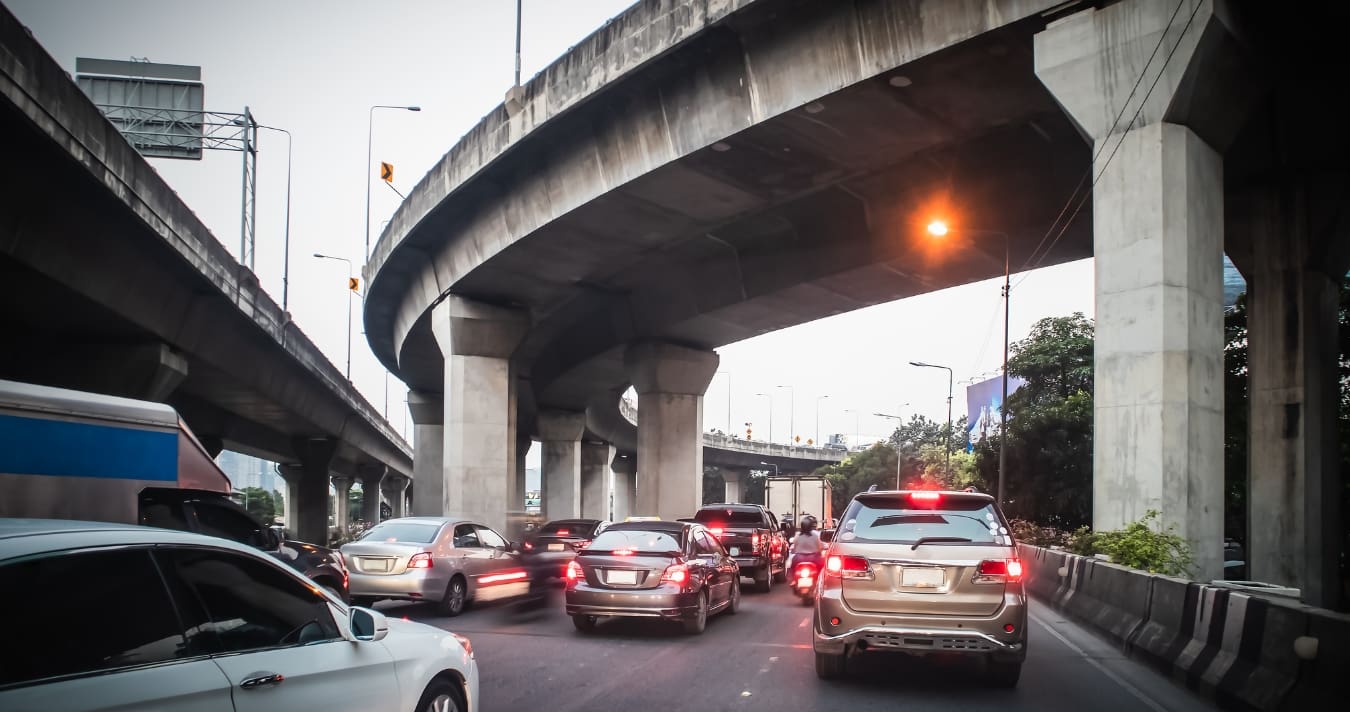
Once scale is assessed, the next step to consider is motion, or physics. And, the difference between a road trip and driving in the city is continuous motion. On a highway the wheels turn and you can watch things pass, choosing your own adventure as you reach the destination. But, in the city, the experience in an automobile is deadlock. Gridlock. If motion is freedom, then a bicycle gives you the same sense of freedom that a road trip gives you, only on a daily level. Instead of watery truck-stop coffee and weird roadside attractions, third wave coffee shops and bookstores become your spontaneous stops. In a car, you’re engaged with the country; on a bike, you’re engaged with your city.
Too Close to Drive. Too Far to Walk.
We said that we are creatures of habit. So, it’s not surprising that as people move back downtown, two antithetical patterns appear to overlap. We’ve already mentioned that circadian depth and human scale that we reclaim by living downtown. At the same time, there’s a suburban hangover that we can’t quite shake. For many, the car remains an unquestioned tool. This is fantasy and it’s entirely developmental. Most of us were taught, explicitly or not, that adulthood comes with a set of keys.
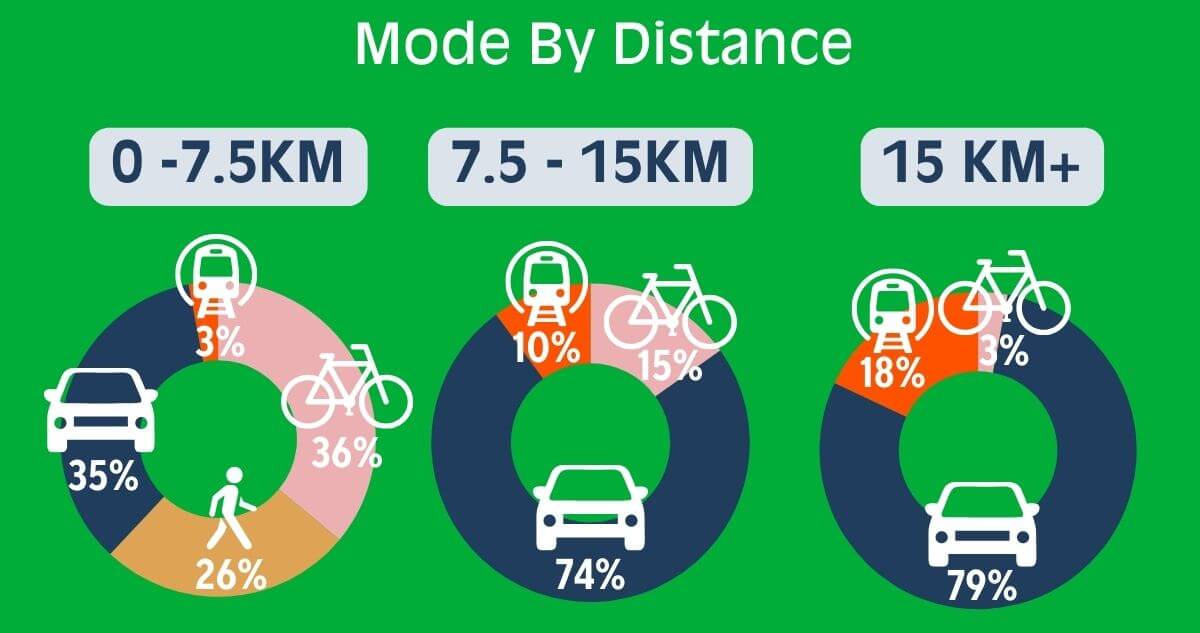
But the problem with using a car downtown is the same problem with walking. Both are dreadfully inefficient. The Dutch observe that people who live the majority of their trips downtown tend to do most of their trips in a radius that does not exceed 7.5km (see Dutch mode-share, above). This 7.5km could be Amsterdam or it could be Toronto. The simple facts are that nearly all downtown distances are too close to drive and too far to walk. Yet, despite this, the majority of car trips in North America are still under three miles. If self-sabotage happens on an unconscious level, this is a fine example.
Except….
Except for people in the bike lane….
Cycle-Analysis
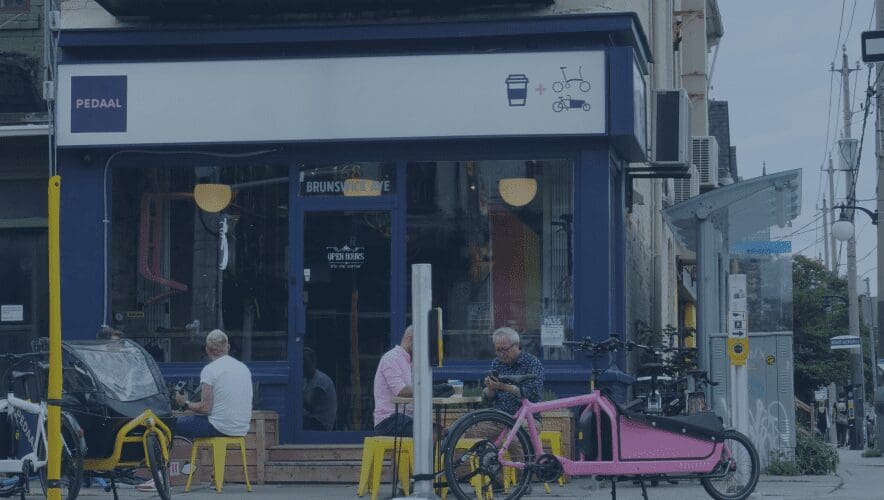
To find yourself in the bike lane usually means two moments of analysis have occurred. First, you have hit the wall with driving downtown. Whether it is cost, frustration, or too many missed meetings, it begins to feel self-defeating. Second, you have somehow managed to reevaluate a bicycle as a serious mode of transportation. That takes a bit of curiosity and a bit of independent thinking. Why? Because the North American bicycle industry tends to be more interested in bikes designed as toys than for transportation. This also, is a suburban hangover. Most people will find themselves riding a bike because civic infrastructure like Bike Share provided the big idea, not the bike store. And, that’s probably a good thing, because bike stores tend to be good at selling exclusionary identities. City cycling shouldn’t be an identity. That’s why our bike store has a coffee shop. It keeps us honest.
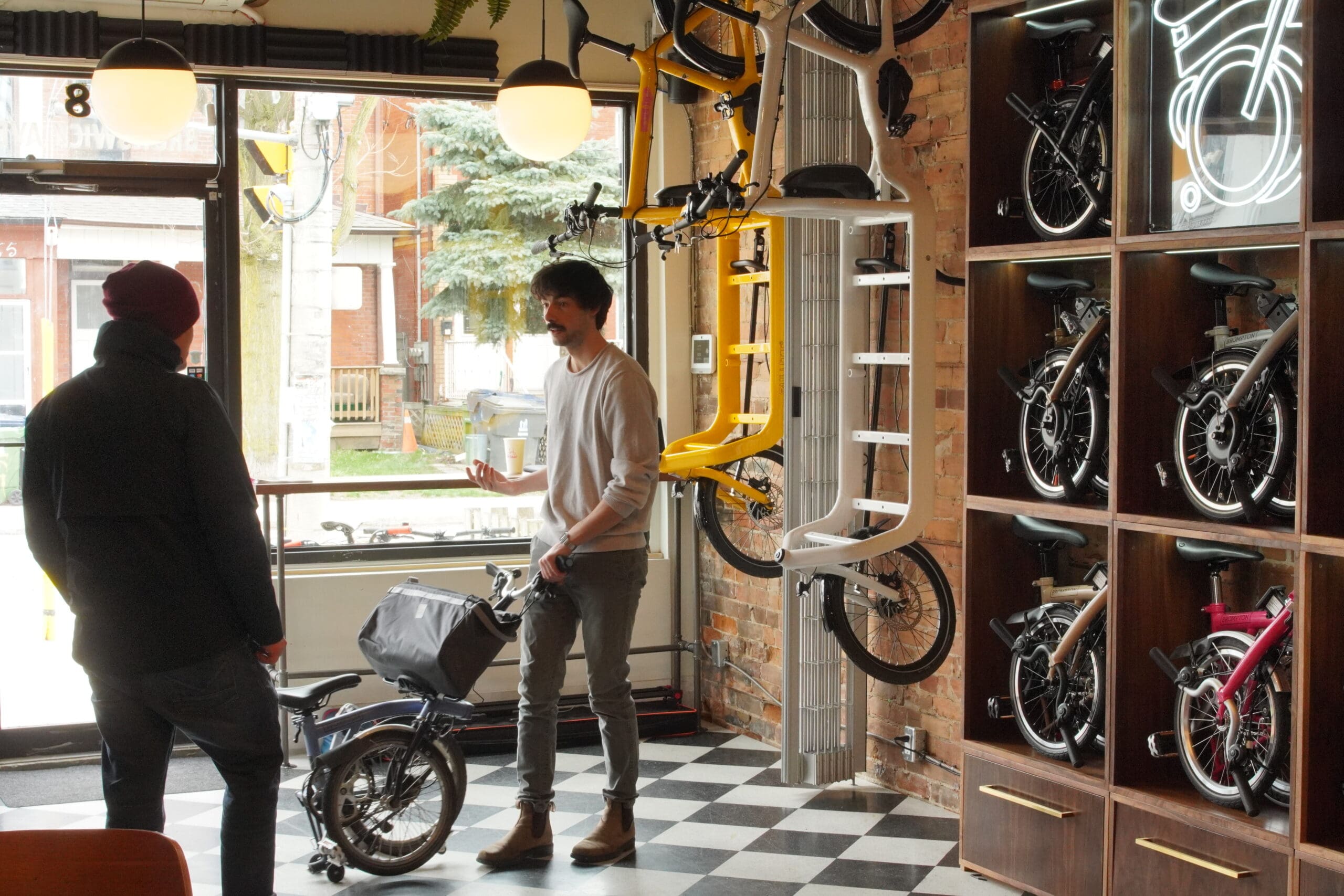
Of course, when you you grow up in the suburbs, an automobile logic makes perfect sense. Here, cars are necessary, and bike shops sell toys. But, when this suburban coding follows citizens and bike shops downtown, that’s where the conflict emerges. As a citizen, it takes a small act of conscious deconstruction to realize that the car is no longer solving urban coverage, and a small act of imagination to see that bikes are not toys but infrastructure on two wheels. Once that shift occurs, the fantasy of downtown life becomes real. Riding a bike in a suit looks entirely sensible, and in cities like Copenhagen, people riding in suits, dresses and heels is a normal part of daily life. It’s a consciousness – and it works here too.
Have a Laugh
Since much of this article has been circling the unconscious, we might as well have a bit of fun with it. After all, the unconscious only really changes once it learns how to laugh at itself. Freud would probably agree. So, if you, like most people, drive for the majority of your short trips, then, hey, you’re completely normal. But like these people, you probably also feel a bit duped. Failure may prove that you’re trying very hard to do things right, but sometimes you have to ask whether “what’s right” is really working. So have a laugh! That’s where analysis begins.
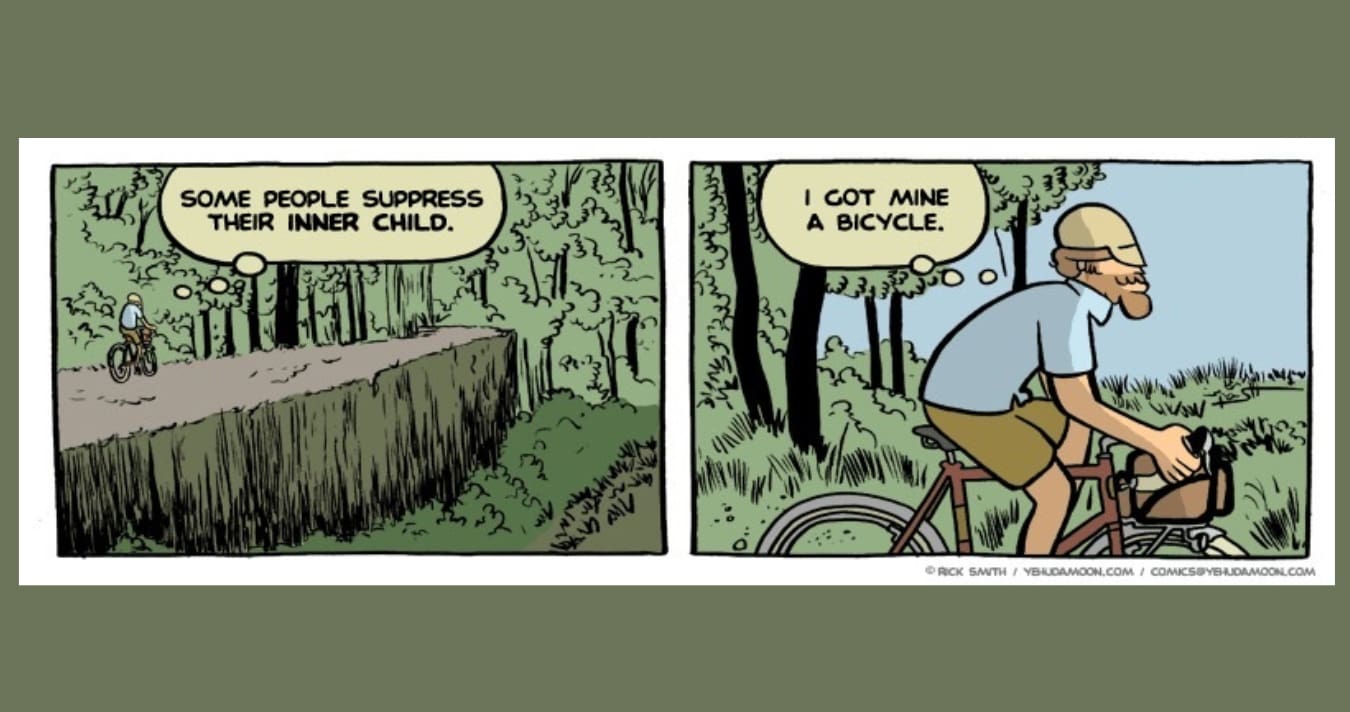
In loose Freudian terms, the superego is the part of the psyche that hands down these ideals you can never quite live up to. It speaks with the voice of your parents and the culture around you. It’s an idealist, it promotes a fantasy, and it’s also a tyrant. In North America, that voice says: grow up, get a car. Driving gets sold as responsibility, maturity, even virtue. The bicycle, meanwhile, gets cast as the indulgence of the id. A silly pleasure. A childish thing. A toy, not transportation.
But, Wait!
What if the opposite where true?
The Urban Reversal
The Dutch offer a useful counterexample. They have some of the highest rates of bicycle ownership in Europe and some of the highest rates of car ownership as well. In other words, they say yes to both freedoms. They use bikes for the majority of their everyday trips, most of which are under 7.5 kilometres, and reserve cars for the distances where bicycles simply cannot compete. In other words, a car has far more capacity over long distances, but that does not make it the rational tool for short ones. It’s all about building a toolkit.
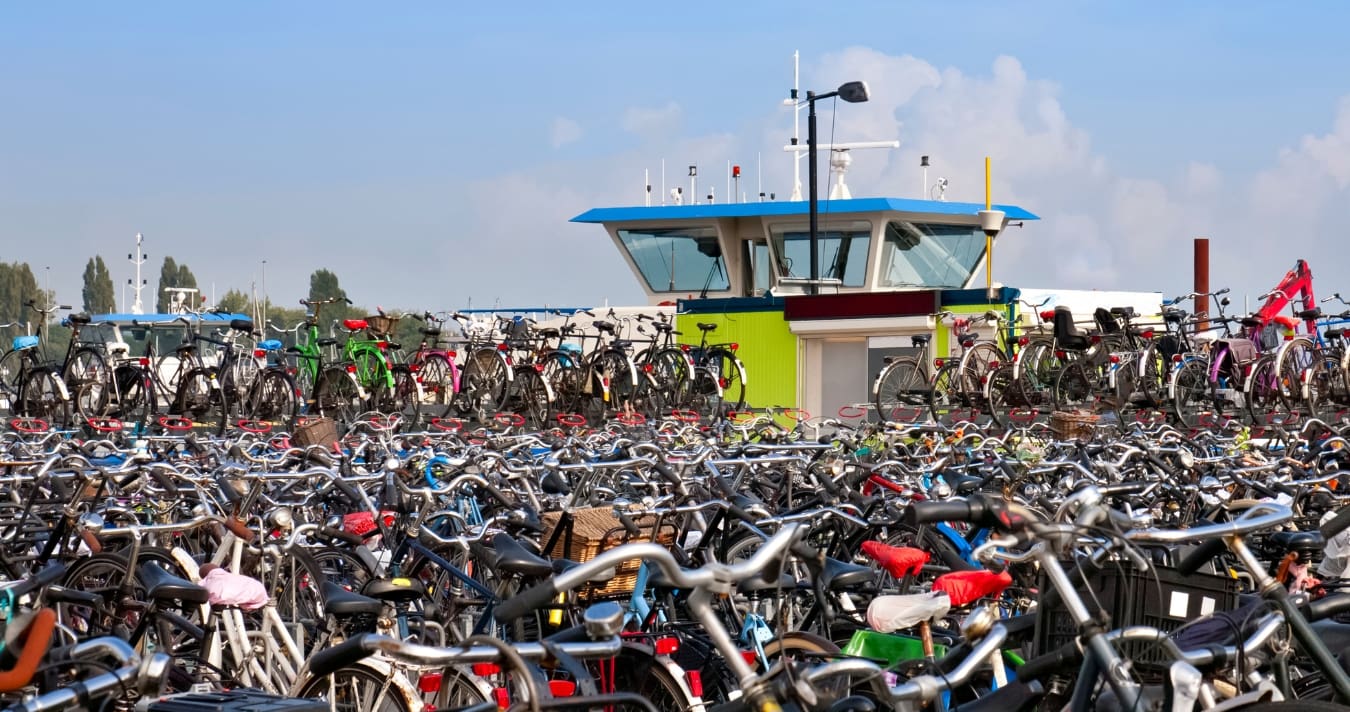
The joke, of course, is that in North America we have the psychology backwards. Like Holland, the bicycle – for most urban distances – is the rational choice. The car is the stuff of roadtrips and play. The result is that your superego – tyrant that it is – cannot argue against a bicycle. Meanwhile, your id takes pleasure driving those wide open spaces. In other words, both the car and the bicycle have their place in the production of pleasure. Freud, it turns out, was not wrong about everything.
Propulsion Compulsion
If this counts as transportation psychoanalysis, or perhaps bicycle-analysis (?), then good analysis eventually requires a numbers check once the laughter ends. Cars are usually purchased with the assumption that they will cover the lion’s share of kilometres in a given year, and in many cases this is true. Indeed, one road trip plus three IKEA runs can easily add up to more distance than an entire year of downtown errands. But, this raises a question: Is it all about the number of kilometers, or about the number of trips?
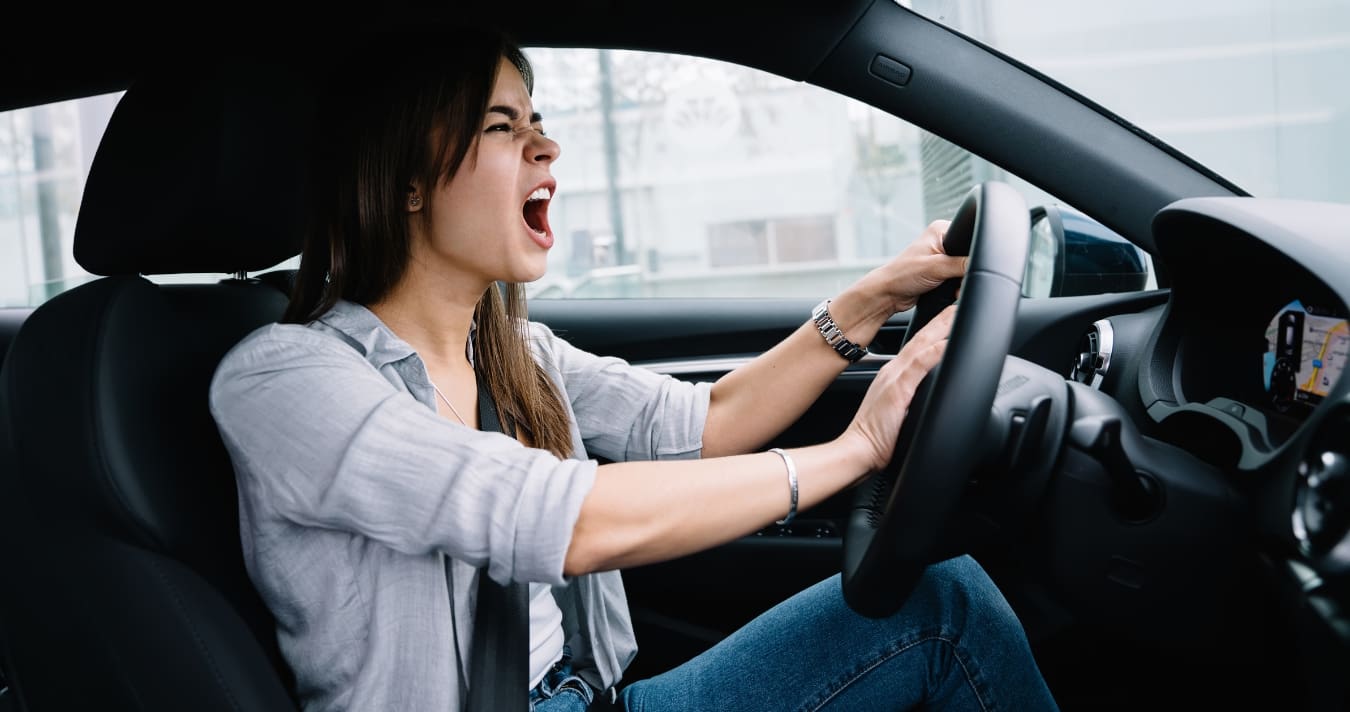
Modern transportation systems tend to measure value in kilometres travelled, yet everyday urban life is structured around repeated short trips. The tension between these two logics shapes how we evaluate mobility. The problem is, if you use a car for the majority of your downtown short trips, the fantasy of the big road trip slowly gets eaten by the cost of the small ones. The pleasure drains out of the system and the car becomes a tool of stress rather than freedom. At this point you either accept the script (Freud calls this repetition compulsion) or rewrite it. Re-riding the script? Yes, that’s what we meant.
The Marchetti Constant
Earlier we suggested there is something ancient pulling people back toward proximity, a kind of circadian preference for daily life that fits the scale of the human body. Interestingly, that instinct does not disappear just because technology increased travel distance. Consider Marchetti’s Constant, the observation that across centuries and cultures people tend to spend roughly an hour a day moving around, no matter what the technology. That hour sticks. The only thing that changes is how much distance we try to cram inside it. And, what that distance ends up costing. The question, in other words, is one of burn rate.
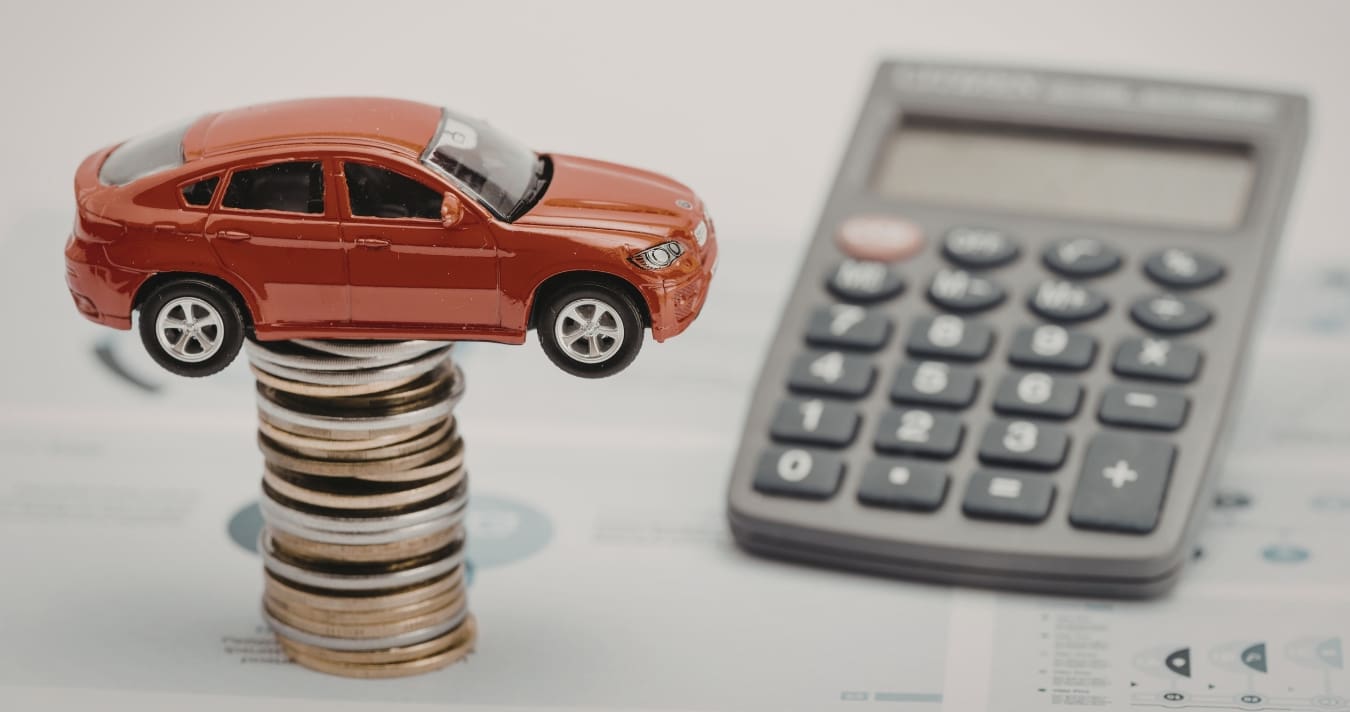
In the United States, that hour often stretches across roughly 22,000 kilometres a year per driver. At something like $0.70–$0.80 per kilometre all-in, that works out to the better part of $16,000 annually just to move. Meanwhile, a bicycle lives on a different scale entirely. If you use your bike for the majority of your downtown trips, you’ll average around 1,000 kilometres a year. Even with generous maintenance and depreciation, the cost barely cracks a hundred dollars. In other words, the hour is the same but the burn rate couldn’t be more disparate.
Affordability
So, the question is not, can I afford a bike, but can I afford a car? And, a car is something we want you to afford! So, let’s take a look at three cases real quick.
For someone who earns good money and can absorb the cost of a car, the irritation is less about money and more about feeling like a sucker stuck in traffic. Sitting in traffic in car optimized for speed and distance begins to feel embarrassing when traffic is bumper to bumper (and all those well-dressed cyclists are whizzing past you). Gridlock democratizes everyone. But, so does a bicycle. The difference is that one makes gridlock the great equalizer while the other keeps everyone in motion. If freedom is tied to movement, a bicycle always wins. Maybe not in the suburbs, certainly not on a roadtrip, but definitely downtown.
Premium Gridlock
For someone who can afford a car but has hit the wall idling in traffic, the numbers begin to hurt. Thousands of dollars a year are disappearing into short trips that do not require a car. The minute you redirect enough of those trips to a bike then your health and finances see an immediate shift. And so, the car does not need to disappear. Your dream of a summer road trip remains, and you have plenty of extra money to splurge for that better hotel. Meanwhile, your commute becomes as pleasurable as a road-trip – a virtuous cycle! In short, all the reasons why you choose to live downtown begin to make sense by virtue of this bicycle.
Many of drive a car even though we can’t afford it. That’s because we were handed keys and a script. We kept driving even when the distances shrank. We kept paying even when the task did not justify the tool. If you replace the majority of those short trips with a bicycle the pressure begins to lift. Suddenly, life becomes affordable. And, whether you keep the car or not, you now have the money to rent a car whenever you want, or buy that plane ticket to somewhere exotic. You own your life again, and that ownership feels good.
How Do I Get Started?
The bikes we sell are precision transportation tools – very different from what you see at most bike stores. But we’ll admit that very few people walk in, buy one, and become a city cyclist overnight. In Toronto, most people arrive at city cycling through a Bike Share membership. For roughly $100 a year, Bike Share solves the problem of theft and is built for last-minute trips. These systems are typically installed by cities aiming to reduce gridlock, which in turn improves public health and expands economic opportunity. The bikes themselves are commercial grade – which is to say: heavy – but they place the rider upright, feel solid and safe, and are quite comfortable.
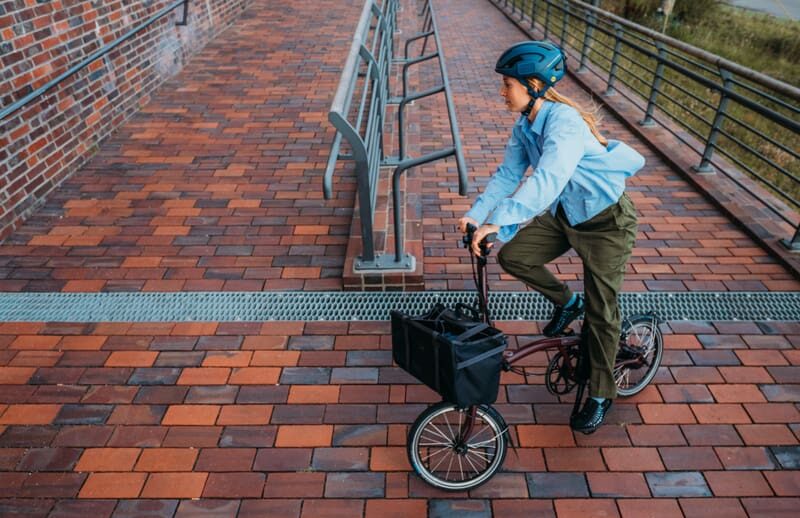
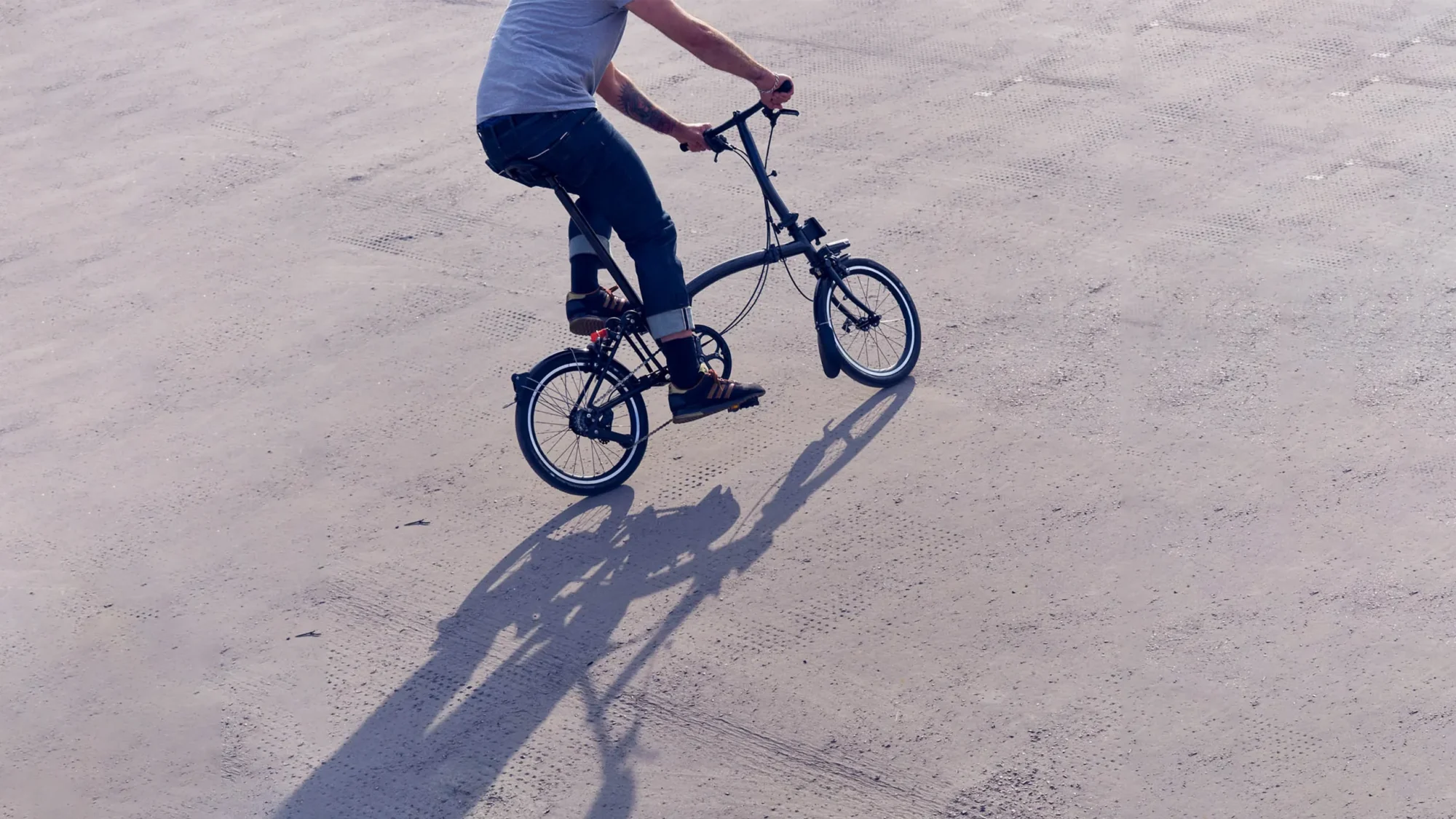
After a year or two, we observe that many Bike Share members begin looking for a personal solution. If they carry kids or cargo, they move toward a cargo bike. If they need something that can come into a condo or workplace, they choose a folding bike. Folding bikes, in particular, answer the unique geometry of the city. The space between home, work, and play is often flat and manageable, but once inside, the city stacks vertically. A bike that can come indoors, eliminating the risk of theft, that can be carried upstairs, and that folds neatly beside a desk becomes the logical solution.
The Principle is Pleasure
We began with the sensation of pedalling once and coasting twice as far because it captures something simple about scale. A car excels at long distances. Downtown life is composed of short ones. When those short trips are consistently done by car, the cost in money, time, and stress adds up faster than we admit. A bicycle recalibrates that equation. For urban distances it restores continuous motion and reduces the burn rate without demanding ideological commitment or lifestyle overhaul. The argument is not to abandon the automobile, but to use each tool where it is structurally suited. When transportation aligns with distance, the daily friction eases and the city begins to function at human scale again. A conscious adjustment, repeated often enough, becomes a new unconscious. That is where the pleasure principle does its work.