
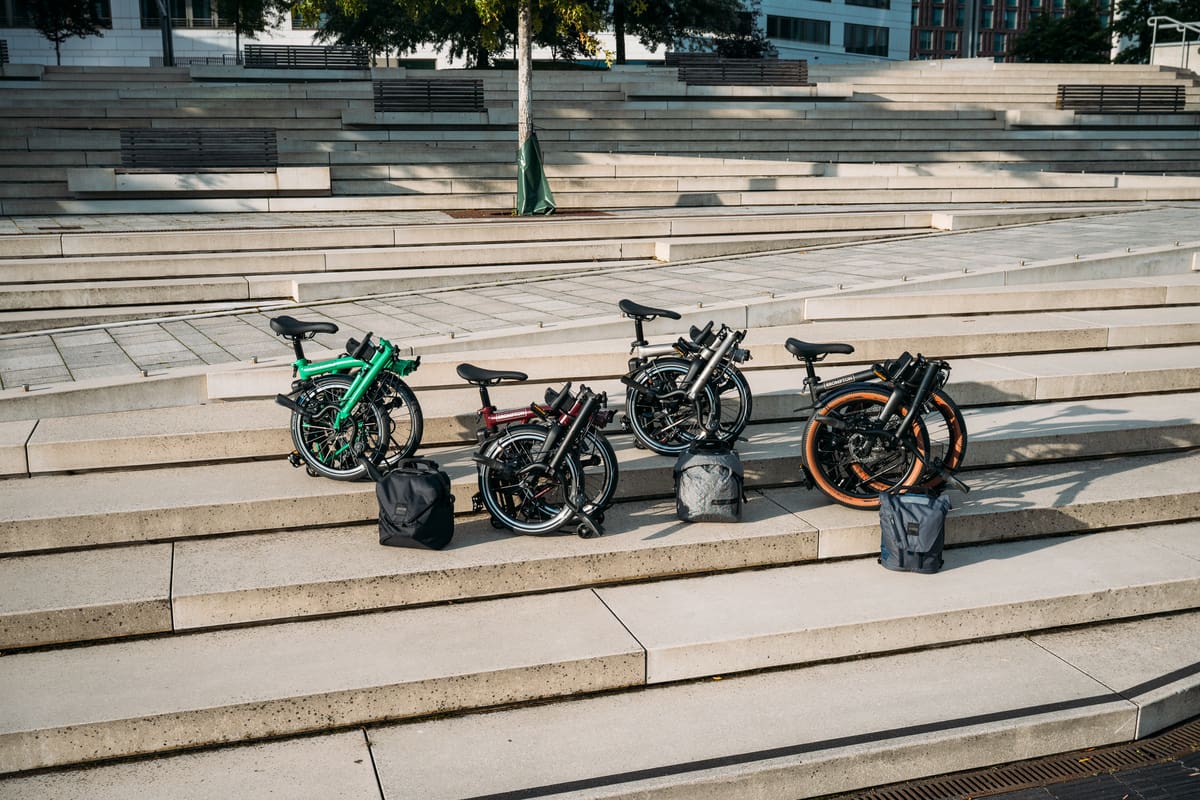
Motiq. No one outside Brompton seems to know exactly what the word means. We’ve guessed that it might be an acronym from project management: Money, Organization, Time, Information, Quality. If so, that would be an internal joke, given that this project has been in development for nearly twenty years. Or, perhaps it’s a mash-up of Motor and IQ. Or, some kind of ephemeral emotion? Maybe it’s all of the above. Whatever the origin, the important part is what the name represents. e-Motiq marks the moment Brompton finally aligns the motor, the frame, the gearing, and the purpose of the bike in the same direction.
Reframing the Problem
Sometimes the only way to solve a problem is to change the frame. And, Brompton did that literally. Brompton has always been obsessed with one mission: build the most efficient, cost-effective and conclusive tool for last-mile city commuting. The majority of city trips are short. An average automobile trip is under three miles. Yet we sit in traffic anyway—breathing exhaust, burning time, and fraying nerves. Our bodies aren’t designed to be trapped in a metal box for short trips that could be done on a bike.
So, if a bike can fold fast, move between indoors and outdoors, and remove friction from the day, this engineers the change Brompton seeks. If that same bike also happens to fit in a campervan or take off on a multi-day tour, then that’s a bonus feature happily baked-in. Taking this mission seriously meant building an electric Brompton. At maximum, an electric bike shrinks distance and flattens terrain. That’s great for longer and hilly commutes or adventures outside the city. But, in the city, and at minimum, it means you arrive sweat-free at the office. Just like you would driving a car, but without the cost or high blood pressure.

Why the Rear Motor Changes Everything
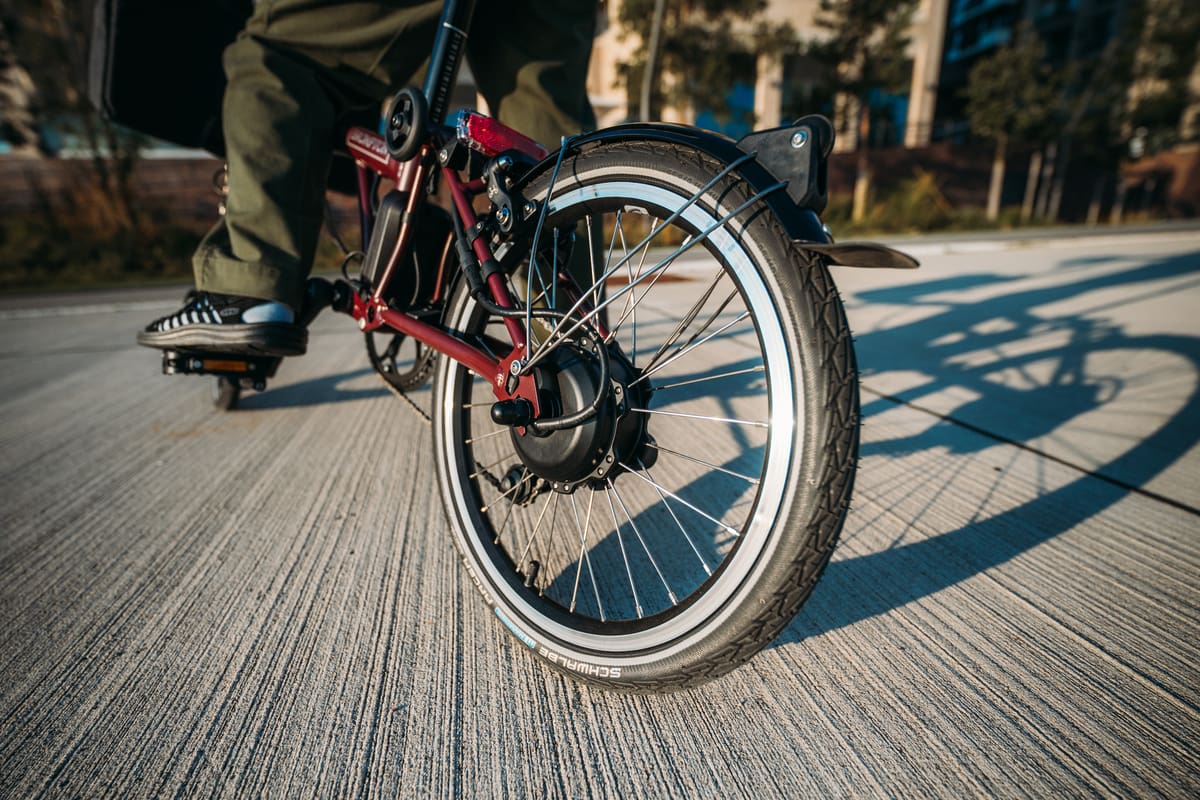
The project for a Brompton Electric began back in 2006 — the same year Brompton introduced its six-speed drivetrain. In hindsight, gearing turned out to be the key that reframed the entire electric problem. Fast-forward to today, and the e-Motiq arrives just one year after Brompton completely reinvented its gearing architecture around real rider use. That meant four speeds for the rider who lives inside the city and twelve speeds for the rider who wants to explore outside it. The shift here required more than new cogs — it required a new frame. Brompton widened the rear triangle to accept a four-speed cassette and, finally, a rear-hub motor.
Indeed, the biggest shift with the e-Motiq is the motors reposition from the front to the rear. If you’re designing from first principles, this is how it should have been all along. The rear wheel accelerates. The front wheel handles. Power belongs at the back; steering belongs up front. But Brompton couldn’t push from first principles, it had to pull a lot of gears together first. So Brompton developed a front-hub system while simultaneously developing the frame that would eventually make the front motor unnecessary. Only when the frame widened—and the gearing matured—did the door open for e-Motiq.

Four Speeds, One Motor, Zero Anxiety
When the new four-speed drivetrain arrived in 2022, city riders immediately understood it. It was light. It was minimalist, and it was intuitive. And when that same drivetrain was paired with Brompton’s three-speed internal hub to create twelve speeds, it became one of the widest ranges you could get on a non-electric folding bike. Loads of gears make sense when your legs are doing all the work, but with an e-assist things are different. This is why Brompton no longer makes a twelve speed electric bike.
To explain, allow us to go into a bit more detail. On a regular bike, you shift constantly: downshift for hills, upshift for speed, always searching for that perfect cadence. On a pedelec, this workload is shared. With a pedelec, the motor reads how hard you’re pushing, how quickly you’re spinning the pedals, and how fast the wheel is turning. It matches your cadence and boosts in extra power only when needed. On a hill, torque spikes and the motor fills in the missing “gears.” When you crest the hill, it fades into the background. In sum, the motor becomes the all those extra gears you don’t have to shift through.
Other Cool Features
The coolest thing about Brompton’s pedelec is that it also quite literally learns you. For the first hundred kilometres, the motor behaves almost like a researcher. It observes how hard you push away from a stoplight, whether your cadence is smooth or choppy on hills, how often you’re forced to start and stop in traffic. It tracks torque, cadence, and wheel speed and builds an internal profile of your riding style. Once it knows you, the bike becomes even more intuitive. That means your range estimates are no longer theoretical projections and actually quite personal.
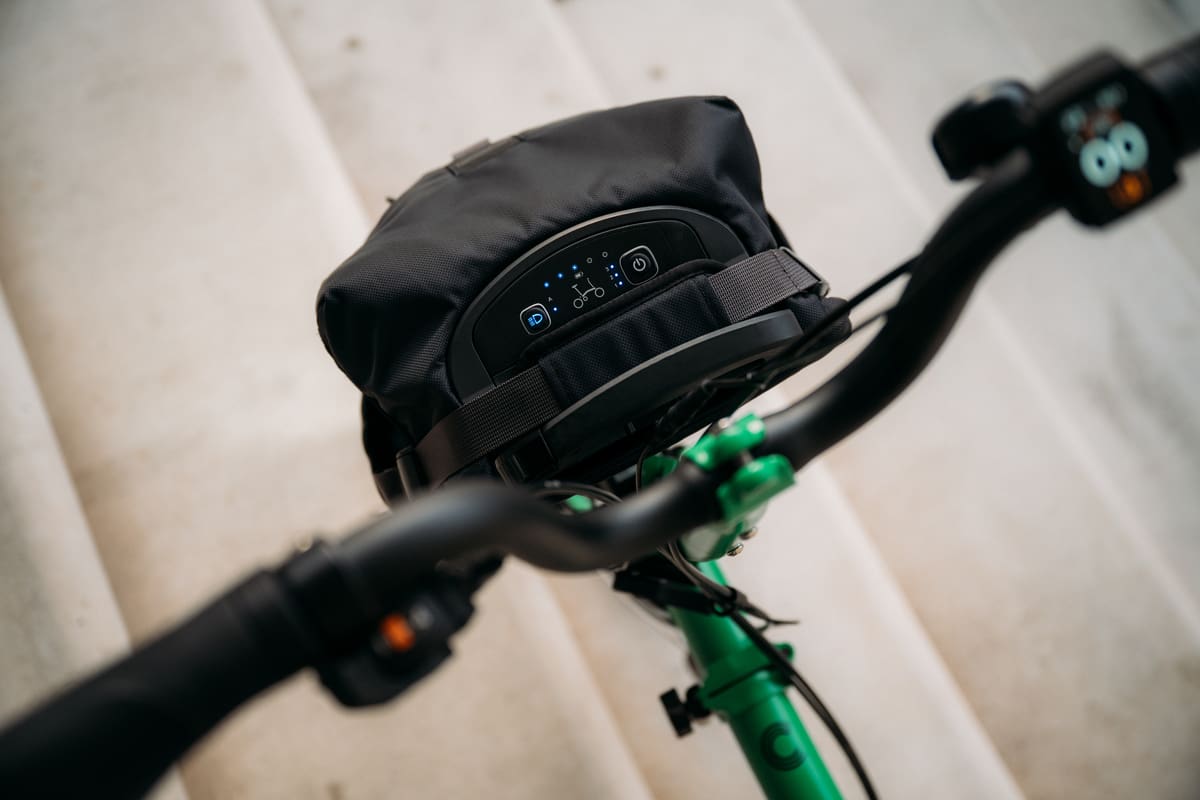
We often mention that the Brompton’s small wheels are perfect for the constant stop-and-go of city traffic. A small wheel accelerates faster than a larger wheel, and that makes it perfect as you jump between stoplights. Of course, the one thing you could never control was a red light in the middle of a steep hill. Well, now you can. The e-Motiq’s Start Assist is designed for exactly those moments. No matter what gear you’re in, hold the button and the bike moves up to six kilometres per hour without pedalling. Once you pedal, the system hands over to full assist.

If this isn’t enough, the new e-Motiq has several other improvements as well. Range has been bumped up to 90km and the system weighs about one pound less than the previous front-wheeled version. And, this is seriously a very lightweight bike. To investigate, let’s jump into each Brompton line.
Weight, Carrying, and What Actually Matters
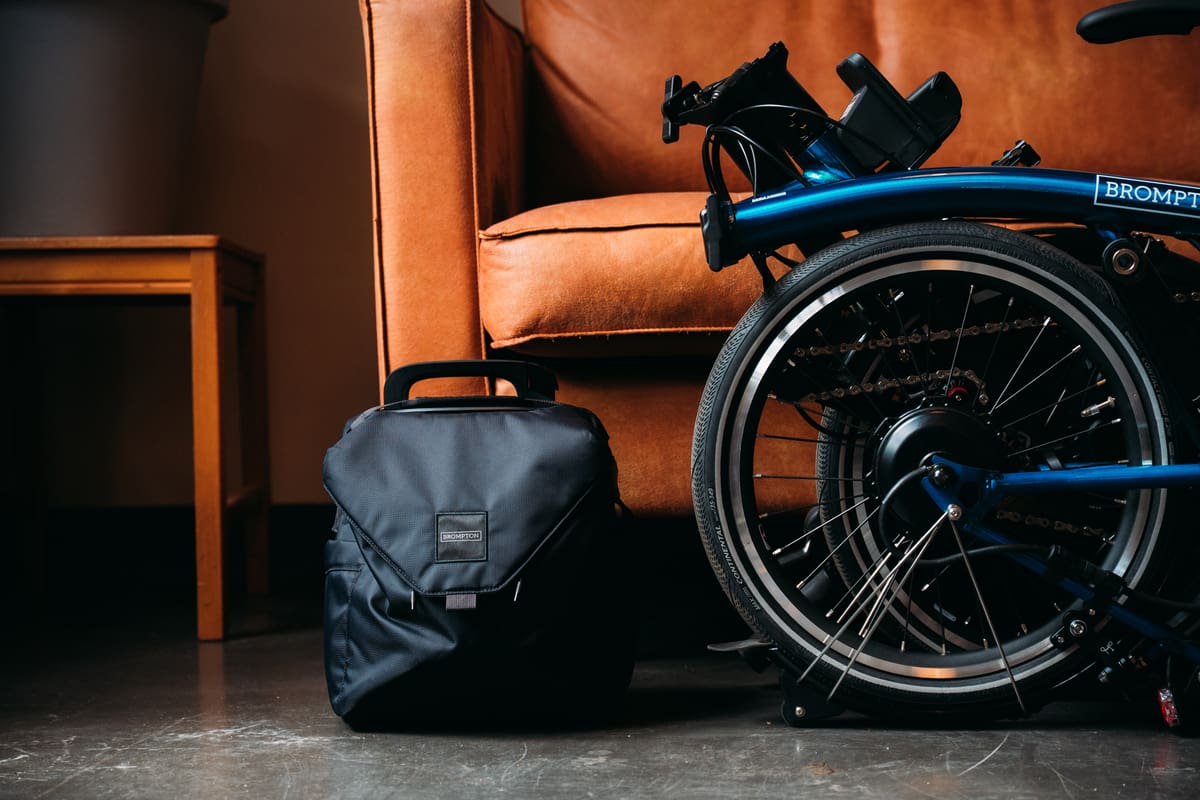
Before talking weights, we need to define which weight actually matters. When Brompton lists a bike’s weight, that number includes the battery. But when you lift a Brompton — onto a train, into a car trunk, up the stairs — the first thing you do is pop the battery off and sling it over your shoulder like a small messenger bag. Instantly, the bike becomes five pounds lighter. That’s the real “carry weight.” So every weight we list is with the battery removed, because that’s how people actually lift the bike in real life. Let’s break this down.
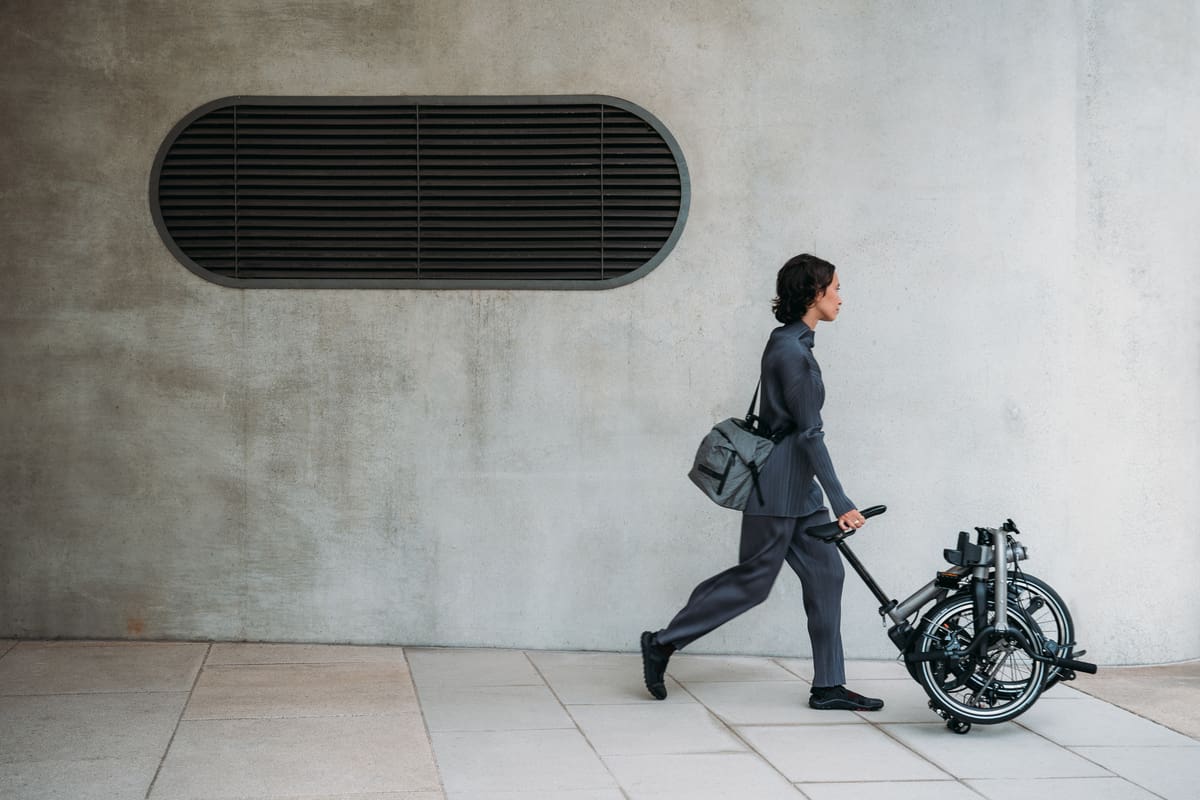
Most new owners picture themselves carrying the bike everywhere the moment they step indoors. In reality, you almost never carry a Brompton inside — you roll it. And the bike is designed to roll in two modes: “shopper mode,” where the seatpost is up and the bike behaves like a cart, and “suitcase mode,” where the handlebar is up and the bike glides behind you like luggage. Unlike carrying, rolling is effortless. But, the real enemy is stairs. Stairs make everything feel heavy. If stairs are part of your daily life, then shaving that carrying weight matters. This helps us unpack each Brompton Electric line. Let’s begin with the C-Line, Brompton’s most economical bike.

The C-Line Electric
The C-Line Electric keeps Brompton’s original spirit intact with its steel frame and lively handling. With the battery removed and slung over the shoulder, the carry weight is roughly 36 lb, making it one of the lightest steel-framed folding e-bikes available. These bikes are expected to land early Spring 2026 and inventory is allocated in the order deposits are received.. You can place your pre-order here or below.
The P-Line Electric
If the difference between Brompton lines is a matter of materials, the 2026 P-Line is the technicolor raincoat. What used to be a C-Line with a few titanium sprinkles is now a strategic blend of steel, titanium, carbon, and alloy that lowers weight, sharpens handling, and improves comfort at roughly half the price of a T-Line.
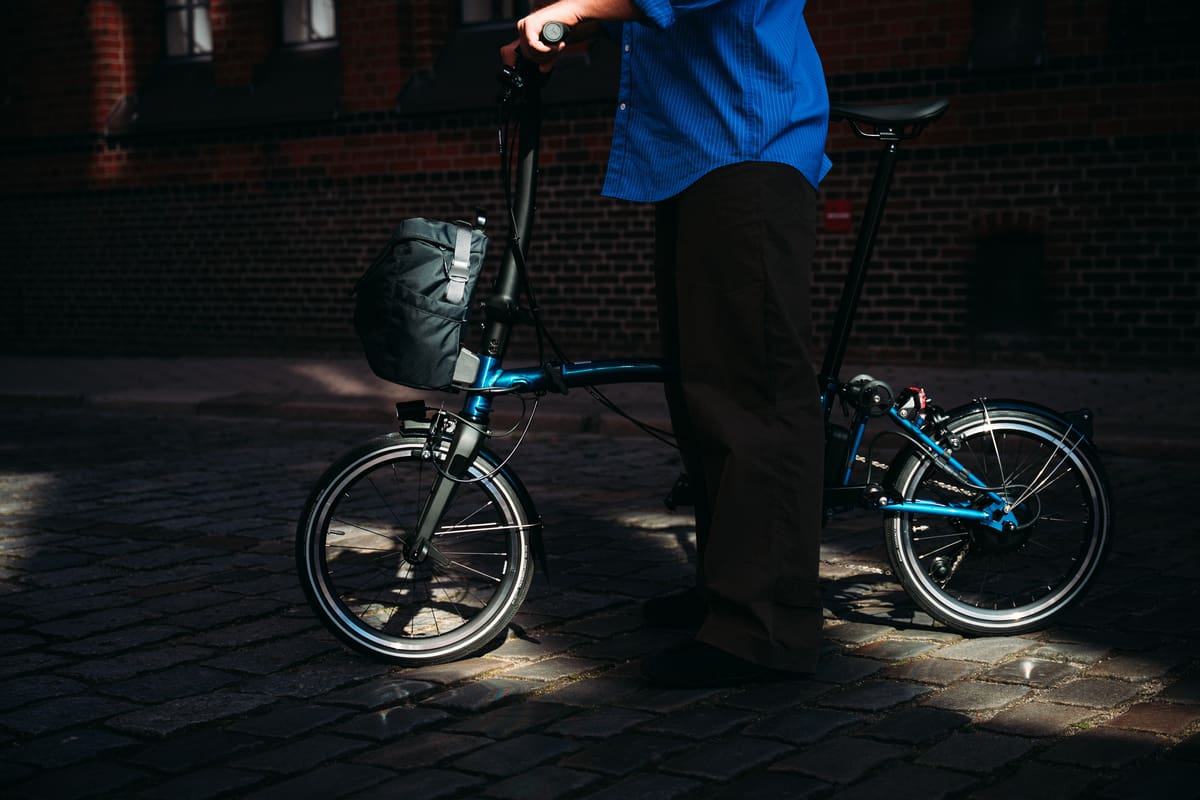
The familiar steel main frame remains, but everything around it becomes lighter and more responsive: the carbon fork comes down from the T-Line, the larged diameter headtube stiffens steering, the titanium rear triangle keeps the ride supple, and the new alloy stem and seatpost borrow a weight-saving trick from the G-Line. With the battery removed, the P-Line Electric comes in at about 34 pounds, hitting the sweet spot for riders whose commute involves stairs, platforms, footbridges, or transit transfers. These bikes are expected to land early late Winter 2026 and quantities will be extremely limited. You can place your pre-order here or below.
The T-Line Electric
The Electric T-Line sits at the top of the lineup and makes no attempt to hide it. With the battery removed, the bike weighs only about 28 pounds. For context, many mountain bikes weigh more than that — and those don’t fold into the overhead rack on a train. Titanium gives the T-Line a different kind of ride. It has spring, not stiffness. It absorbs vibration rather than transmitting it. Add a carbon fork at the front and a carbon seatpost beneath you, and the bike seems to vanish under the rider. These bikes are expected to land early late Winter 2026 and quantities will be extremely limited. You can place your pre-order here or below.
The G-Line Electric
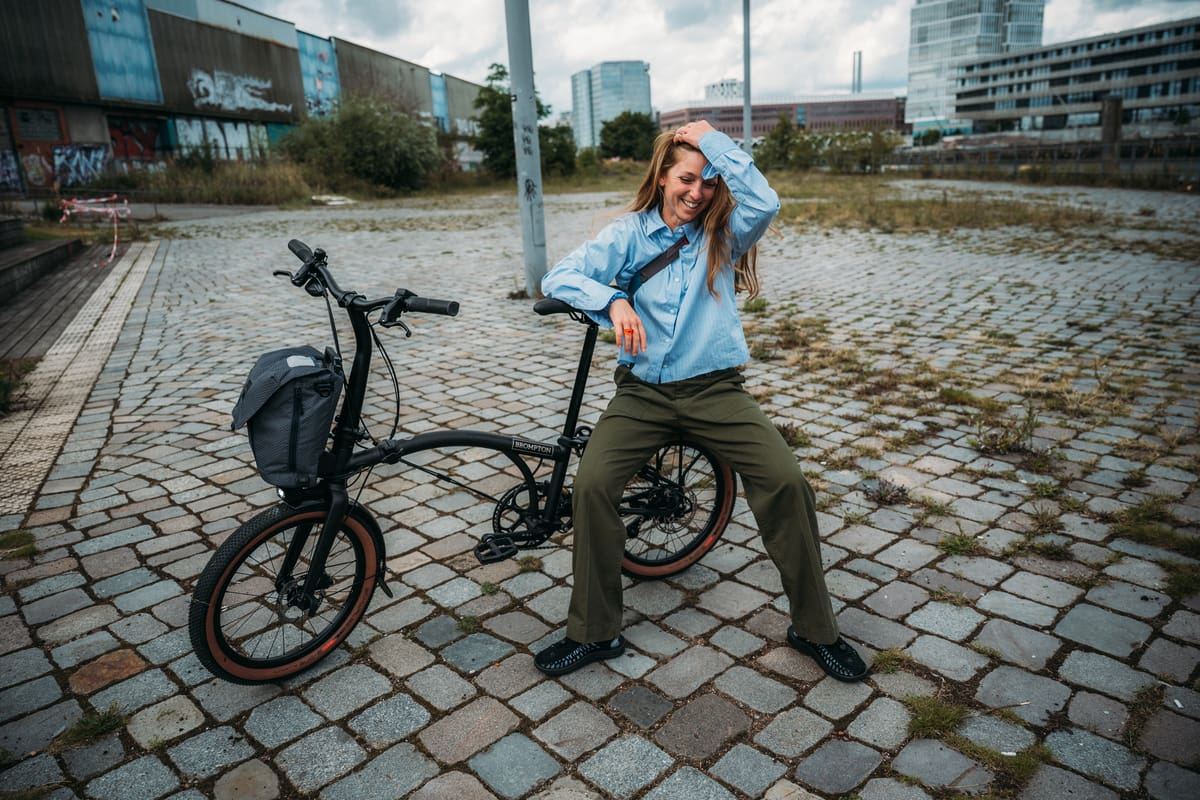
The Electric G-Line is the Brompton that doesn’t wait for perfect pavement. It takes the folding-bike logic of “go anywhere” and applies it to actual terrain. The larger wheel rolls faster and smooths broken surfaces; the new rear-hub e-Motiq motor puts the power exactly where acceleration happens. Together, they create a bike that feels planted, confident, and surprisingly quick off the line. The first batch of bikes are expected to land December 2025 and you can place your pre-order here or below. If you’d like to try our demo bike please email us at info@pedaal.com or book a test ride here.
Conclusion
It is the final piece of a long-term plan that began with a question: how do you shrink a city? The answer was surprisingly simple. Put power where acceleration happens. Use gearing that matches how people actually ride. Let the system learn the rider, not the other way around. Make a bike light enough to carry up a flight of stairs without hesitation and intuitive enough to disappear beneath you the moment you start pedalling.
A Brompton already turns the city inside out. It slips through gridlock, folds into tiny spaces, and turns short trips into quick decisions. Electrification did not change that. It amplified it. With e-Motiq, Brompton closes a long history of development. The frame, the motor, the gearing, and the rider are finally pointed in the same direction.
Next Steps
Got a question? We’d love to help! For quick questions, click the chat button during opening hours or shoot us an email at info@pedaal.com. Want to really drill down with some questions? Book an in-store or remote sales appointment by clicking here. Of course, we’re also a phone call away too! Just dial 416-972-1422, ask for Eric or Timm and we’d love to help!
Related Posts
172 Ways to Build a Brompton (and How We Make Sense of It All)
Most people assume a Brompton just appears in a shop and that’s that. The truth is a little more interesting. Every bike takes its own path to get here, and at Pedaal we like to think that’s part of its story. We keep a wide range of Bromptons in the store so you can see...
stay up to date
Stay in the Know. Join our Newsletter!
*By entering your email, you agree to our Terms & Conditions + Privacy Policy,
including receipt of emails. You can unsubscribe at any time.

Pedaal designated official Brompton Gold Dealer status - Read more