We live in dense cities because we value community, culture and proximity, so now is a good time to reconsider how we glue that life together. Most of us have never audited the way we get around. Is there a way to move through the city that adds value to living in one? Or must transportation always introduce friction and cost?
Distance
Anyone who has read enough of our posts will eventually stumble upon the infographic below. It shows how the Dutch divide transportation by distance. This is useful because there is very little suburban sprawl in the Netherlands, while us newly urbanized North Americans are only beginning to learn what happens when most of life is lived close to home. Learn from the experts, that’s our motto!

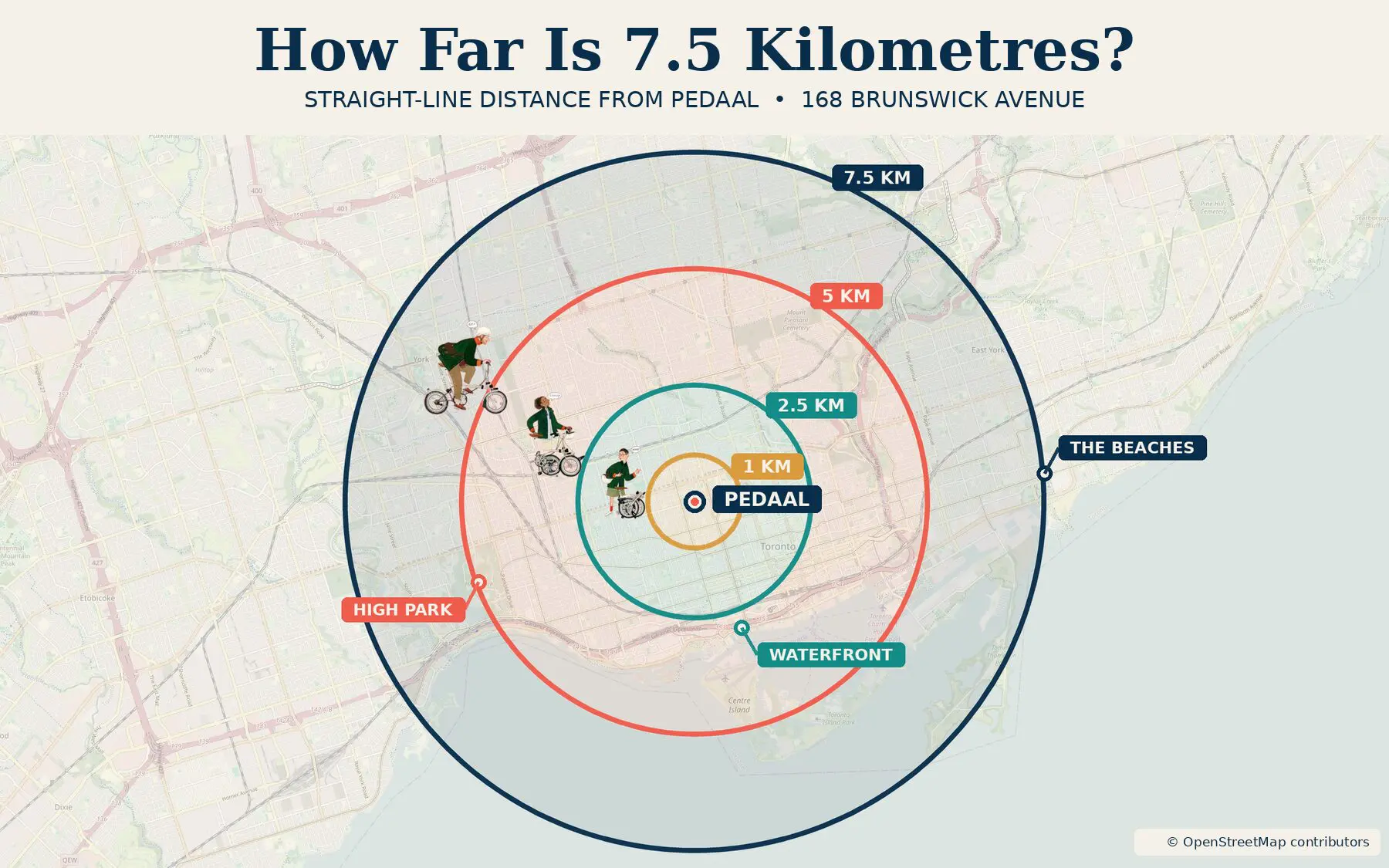
The question to ask is: could this be you? How many of your regular destinations are less than 7.5 kilometres from home? Or, in an internal audit feels like too much work, let’s consider the data. In the heavily suburbanized United States, 52% of all trips are under 4.8 kilometres. And, in the densely urbanized Netherlands, up to 70% of all trips are under 7.5 kilometres. That shows you the difference between sprawl and density: most of the trips are still short.
Practical Inclusions
But, suppose you did take a quick audit of distances to school, work, groceries, gym, restaurants and friends. Like the Dutch, we’ll bet that at least 70% of your journeys are too close to drive and too far to walk, if not substantially more. That’s why, to employ a philosophical term, a bicycle is prima facie necessary for anyone who has recognized the problem. That’s Latin for in your face.
But if you take another look at our first infographic, you’ll see that beyond 7.5 kilometres, the Dutch are uncompromising about the value of a car. The Netherlands has one of the highest concentrations of cars per square kilometre in Europe, while its drivers pay some of Europe’s highest fuel prices. As staunch individualists (this is a fun read), the Dutch also use transit surprisingly little. Like North Americans, they tie the car to liberty and freedom. The difference is that they view the bicycle the same way. A bike ain’t no toy. No, it helps pay for the car.
Scoring Walk Scores
The fact that a bicycle can help you afford a car for journeys beyond 7.5 kilometres is a fecund observation, but it is not our concern here. We want to audit how much not riding a bicycle is costing you within the 7.5-kilometre range that we North Americans commonly call the “last mile.” Let’s begin with walking.
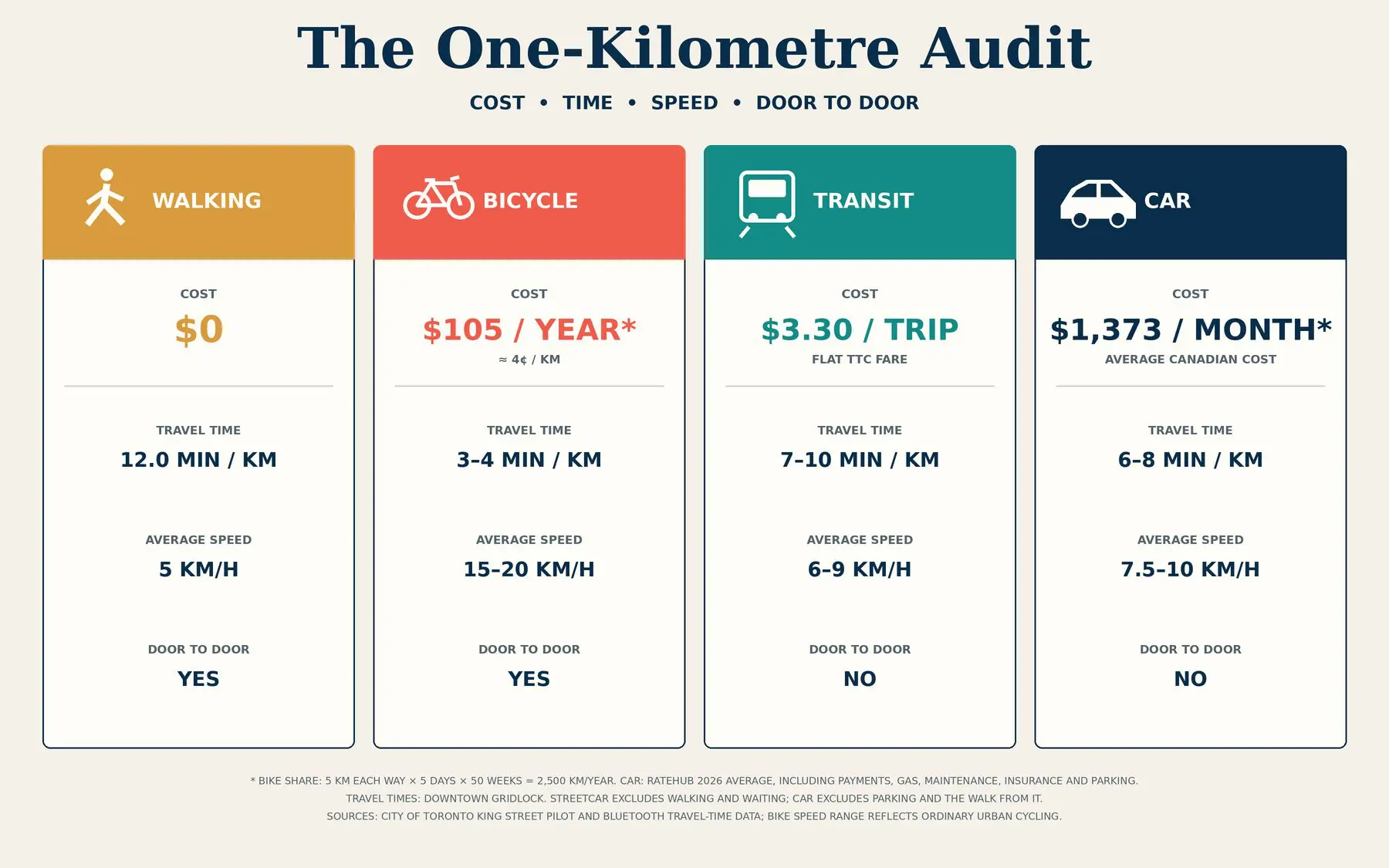
If the “last mile” is a misnomer, and it certainly is, since it rarely describes a single mile, “Walk Scores” only reinforces the false idea that every downtown trip is walkable. It’s another misnomer. Walk Scores are marketing speak for proximity, not how far anyone is actually willing to walk. And, the problem with walking is not money, but time. A five-kilometre walk takes about an hour each way. That’s two hours for a return trip. In other words, walking is only free if your time is.
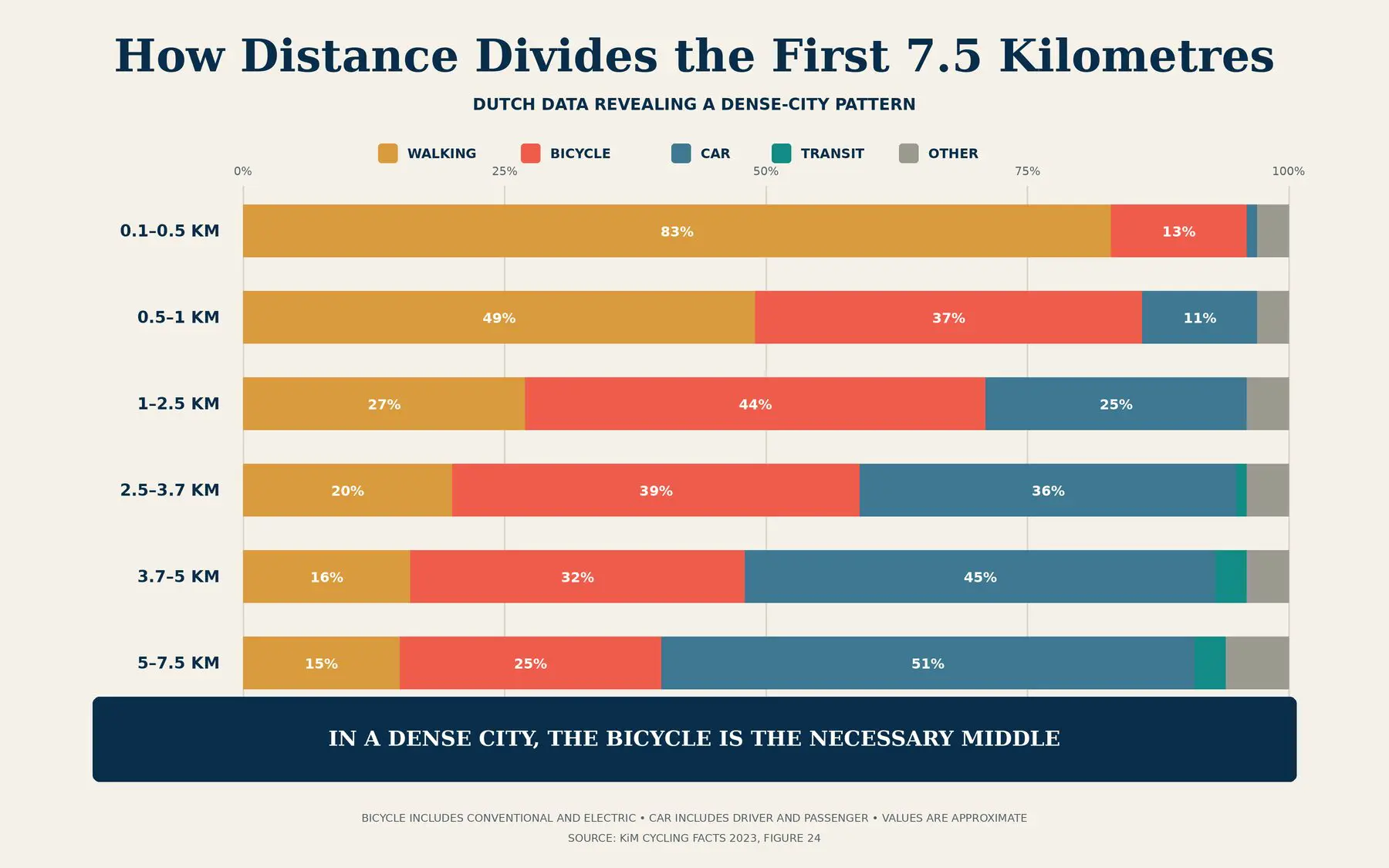
If a five kilometre walk is plainly too far, what distance can a Walk Score honestly describe? Once again, Dutch data helps. In Holland, walking accounts for 26% of trips under 7.5 kilometres, but 56% of all walking trips are under one kilometre. The car, meanwhile, does not decisively compete until distances are over five kilometres. That leaves the bicycle handling the problem of the middle-mile (that’s our term), the wide swath between one and five kilometres. The middle mile is that costly, frustrating and omnipresent gap that walking, transit and driving can’t unlock. But a bicycle can.
Primary Car
This five-kilometre threshold is also helpful when we audit the cost of driving. As mentioned, even in the heavily suburbanized United States, 52% of all trips are under 4.8 kilometres. Earlier national travel data found that 72% of trips within this distance were driven. In other words, North Americans reach for the car at almost exactly the distance the Dutch reach for a bicycle. That’s why we have so much gridlock, it’s all the short trips.
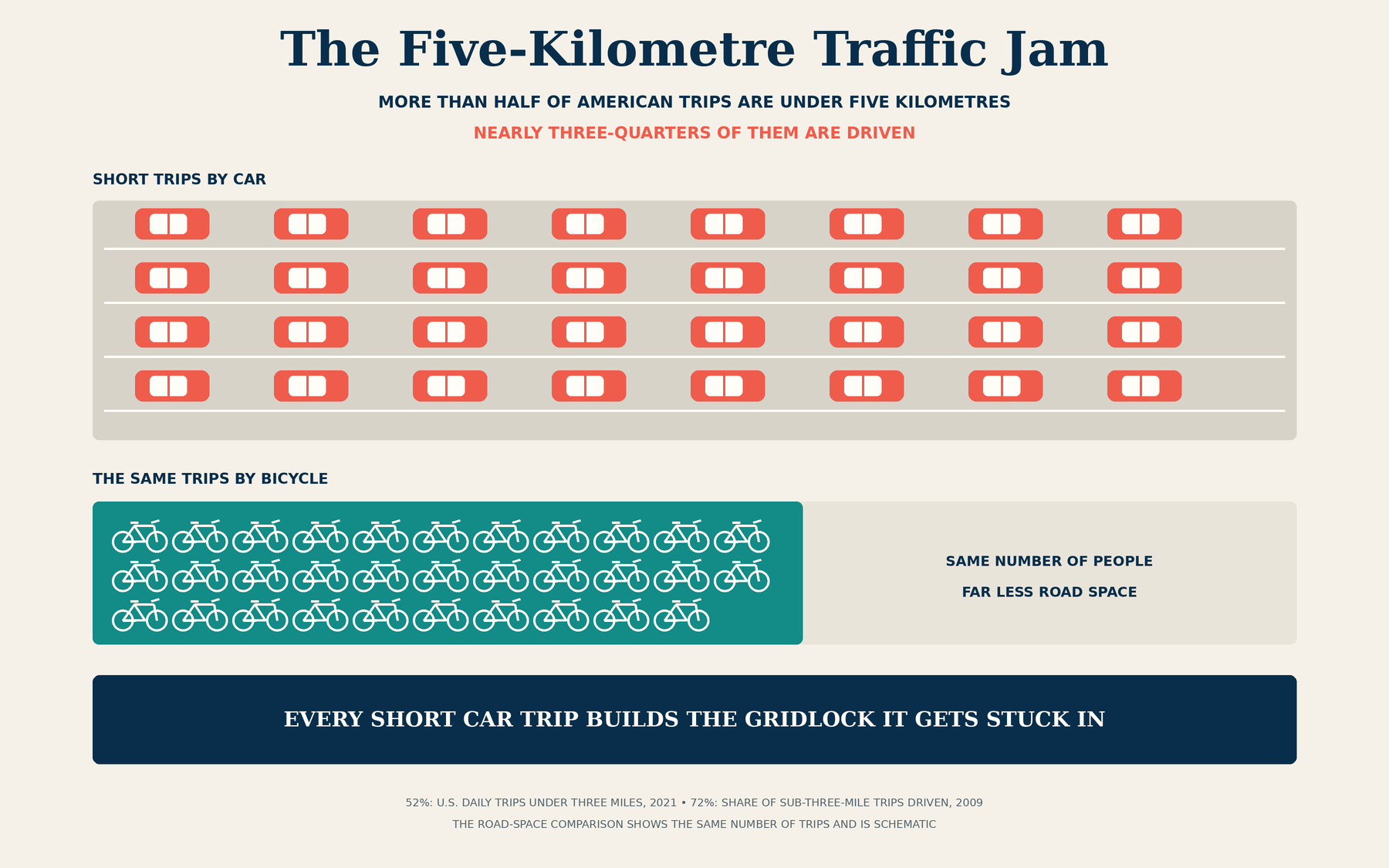
This is where things get expensive, but it also reveals a false choice. If you bought a car because you thought it was necessary to unlock the last mile, you bought the wrong tool. And if you call it your primary vehicle because it covers the most kilometres each year, you are using the wrong measure. It’s not the number of kilometres, it’s the number of trips. Think of it as a competition. The bicycle unlocks the majority of trips in last mile, a car does not. The joke with most of our customers is that their bike has become the “primary car.” Exactly. If you face the facts, a bicycle is necessary while a car is supplemental. That’s prima facie… in your face!
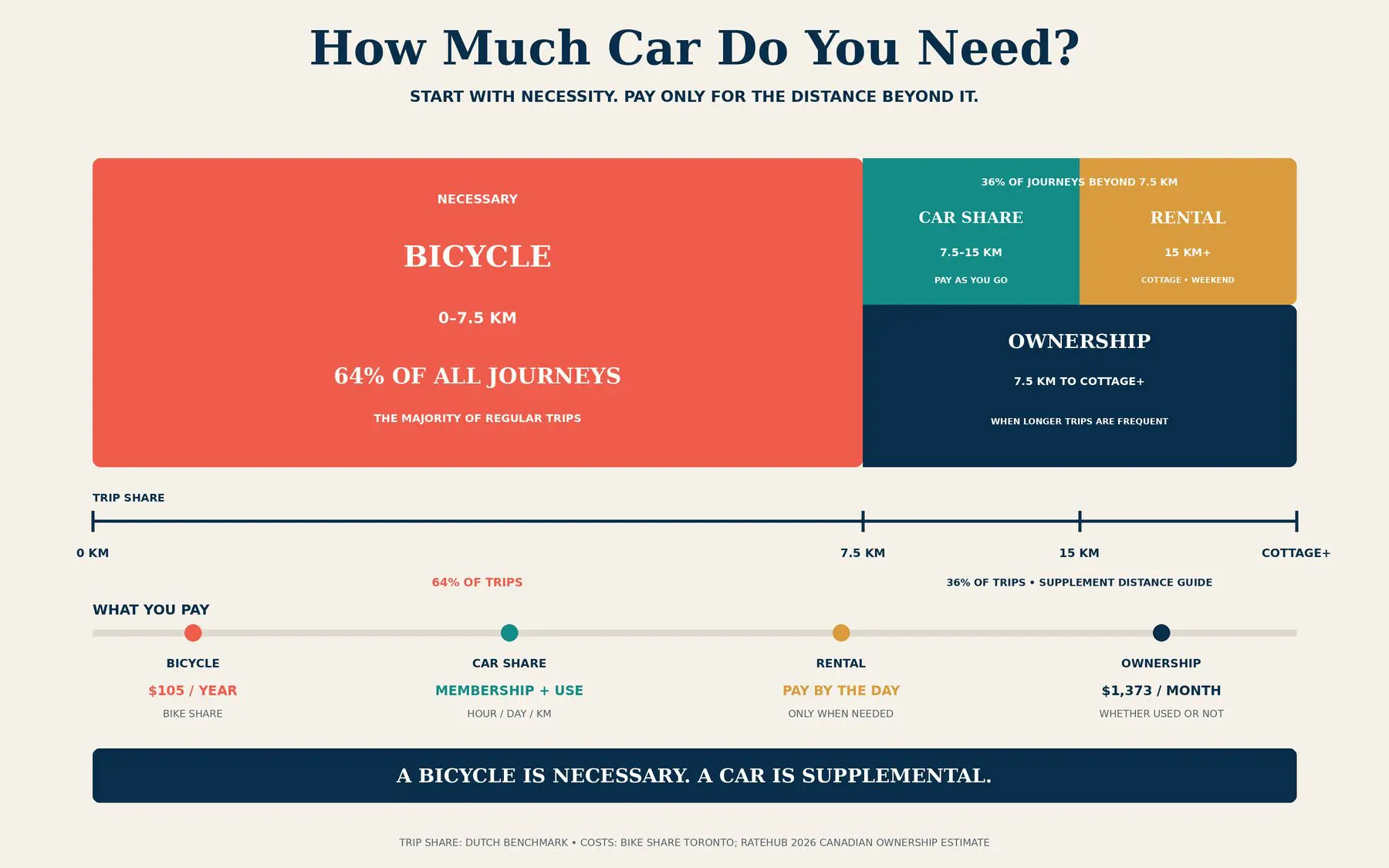
Of course, once the bicycle has solved the majority of your journeys, you can decide how to handle the supplementals. If longer trips happen frequently, then sure, owning a car may make sense. If they happen rarely, then car share or rental may make more sense. So, a car does not eliminate the need for a bicycle. But, a bicycle may eliminate the need to own a car. For Canadians learning to tighten their belts, that distinction can leave considerably more money in the bank for those supplementals. Who doesn’t love a road trip, or a flight somewhere warm? A bicycle keeps your piggybank full.
Whither Transit?
Of course, what is comical about the Dutch is their attitude towards public transit. If you have been to Holland, you will know they have excellent streetcars, buses and trains. Yet transit accounts for only 3% of journeys under 7.5 kilometres. Anyone in downtown Toronto can appreciate why. Taking the subway from Sheppard West, Kennedy or Kipling makes sense because you are travelling over 7.5 kilometres. However, within that 7.5km range, transit usually means a bus or streetcar. That is an order of magnitude slower than downtown driving, and downtown driving is already pretty slow.
The chief objection to city cycling, of course, is safety. But, much of of this is hysterics. Downtowners might scoff at suburbanites who refuse to take the subway because they think it is dangerous, but cycling is treated much the same way. Look around. The people riding through the city are not a tribe of of warriors. They often look remarkably Dutch: a scarf in in the wind, a high heel, a crisp suit or a smart jacket. It doesn’t have to be a fashion show, but a bike lane still makes a pretty good catwalk.
Don’t Buy a Bicycle
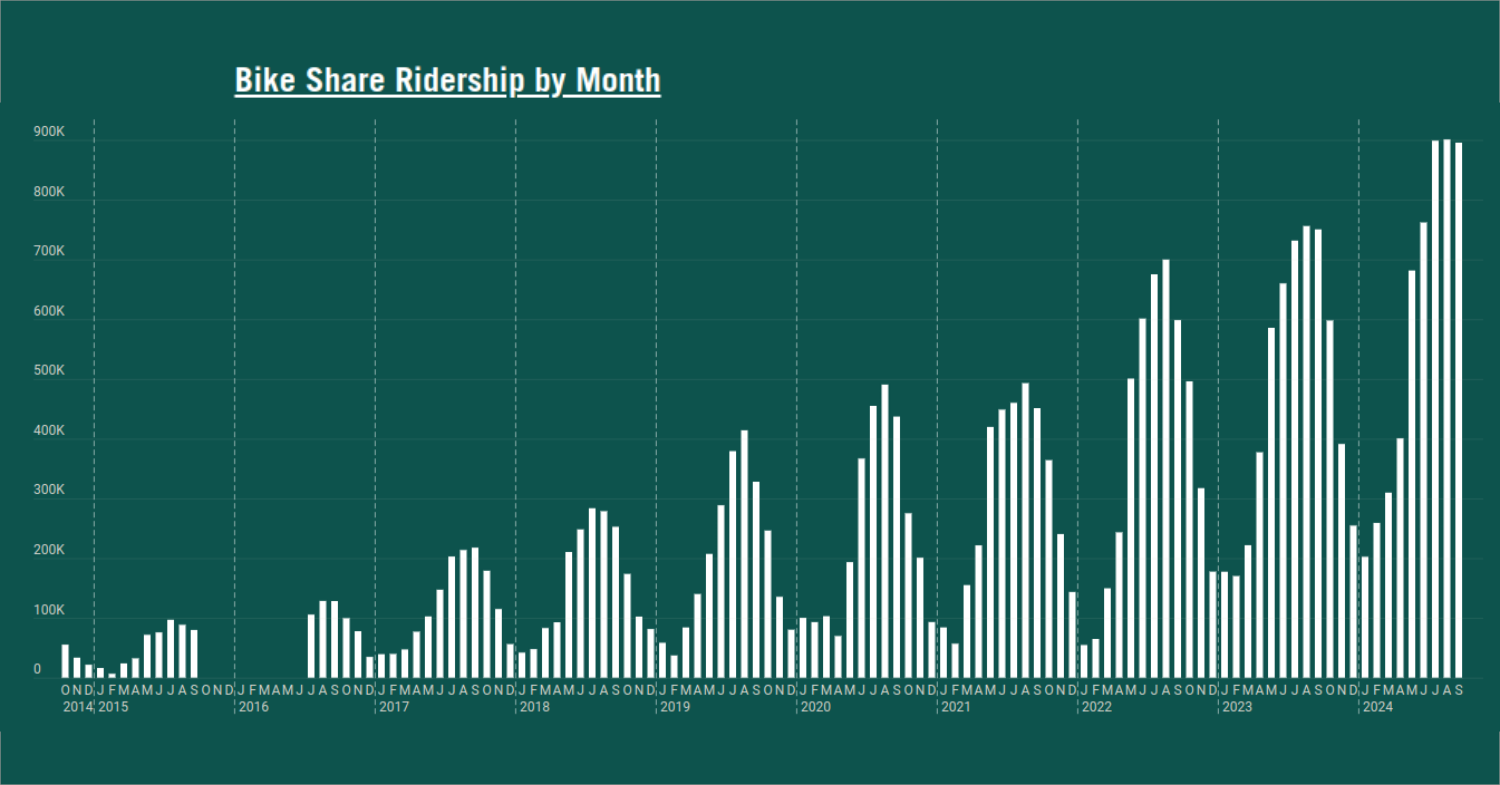
The best way to prove this this to yourself is not to buy a bicycle. Yes, this is a bicycle store talking. Try Bike Share instead. Within a few pedal strokes, especially along Toronto’s many lovely backstreets, you can discover for yourself whether cycling feels safe (guaranteed it will). Bike Share is cheap, quick and nearly door to door. Most of all, it offers the kinetic liberty (that’s another one of our terms) of moving through the city without interruption. Remember, we choose to live downtown because we value community, culture and proximity. A bicycle is how you glue that together without friction.
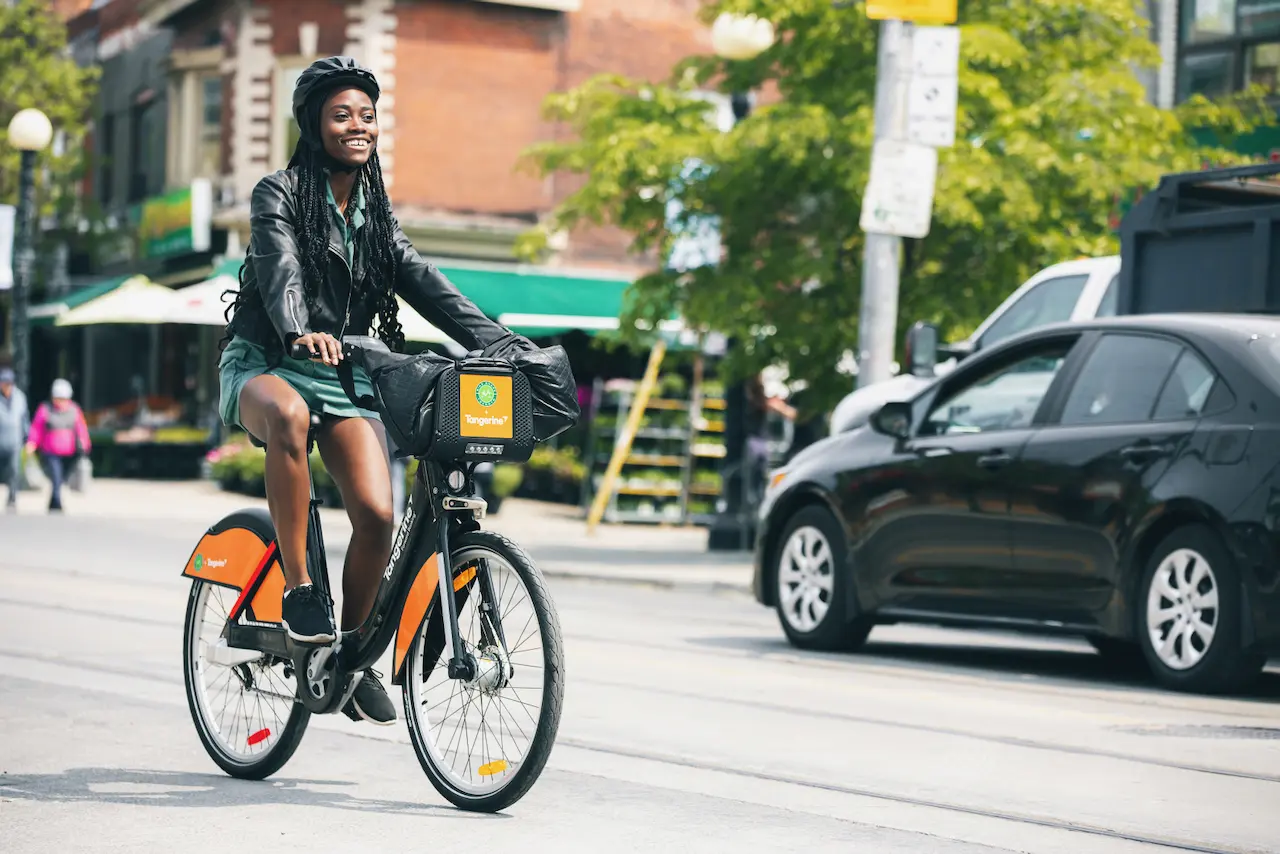
However, we’re still a bike store. We know that Bike Share feels gloriously free in the first year (it’s so cheap that it feels literally free too), but by the end of year two, the broken bikes, heavy bikes and empty docks begin to take their toll. And, eventually, you get tired of walking to the dock. So, when you’re ready, we have the solution.
Obviously, Buy a Bicycle
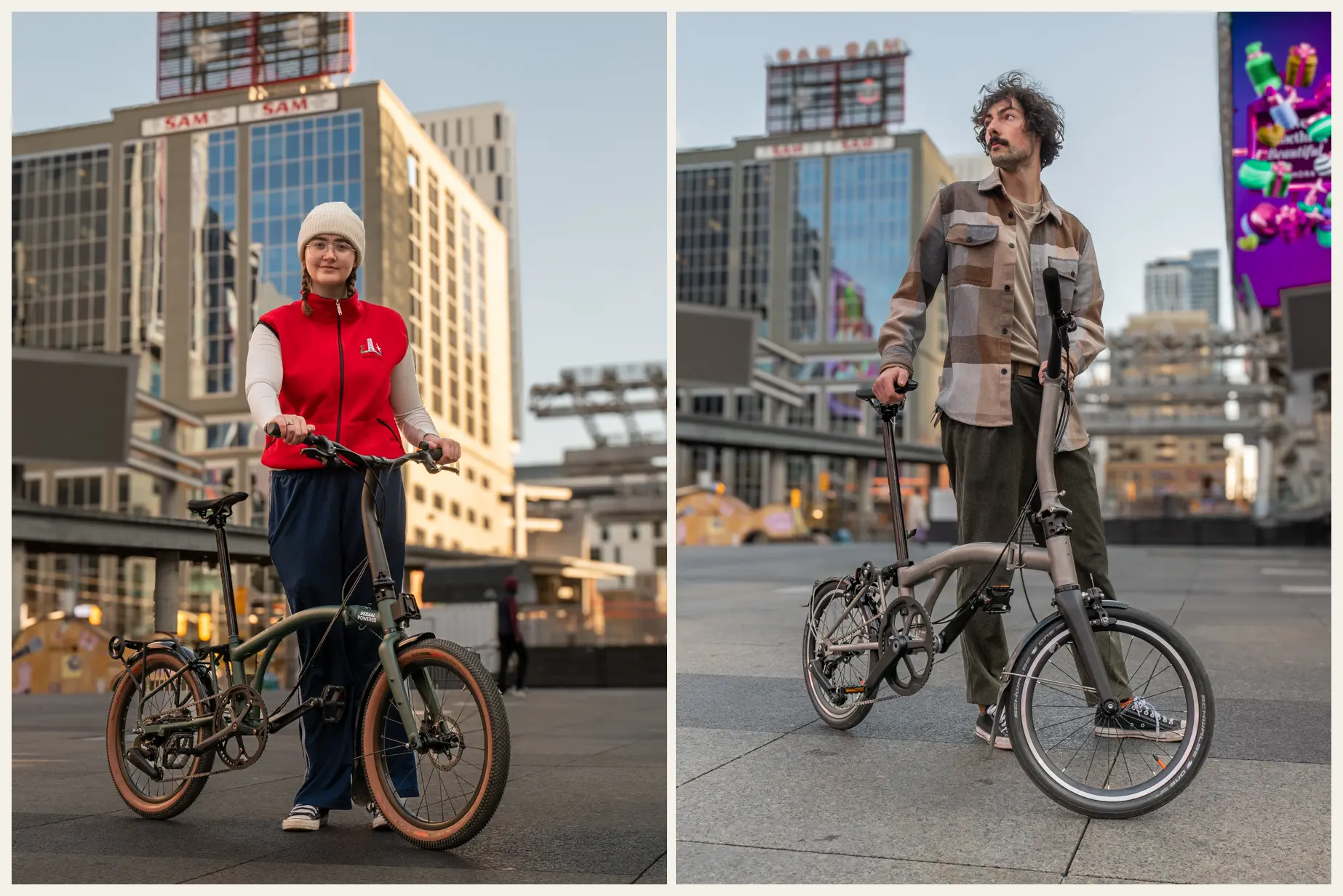
The problem with buying your own bike is theft. Unlike a car or transit, a bicycle takes you door to door. That is its great advantage—until it gets stolen outside the door. That’s why we sell bikes that come indoors. After all, the great truth about riding a bike in the city is that you’re rarely venturing into the great outdoors. If you’re going outdoors, it’s to enter some other type of indoors, whether that’s work, the gym, a restaurant or whatever. Thus, the most frictionless type of transportation in the city will be the kind that follows you through doors. And, that’s a Brompton.
At the same time, living within the last mile does not always mean moving only yourself. Sometimes it means groceries, children or a trip to IKEA. That is where a cargo bike comes in. If you want to truly challenge the premise of car ownership, a cargo bike does exactly that. Because most are electric, they flatten hills and shrink distance. In the Netherlands, electric bikes are already extending the bicycle’s competitive range beyond 7.5 kilometres. Sure, these are parked outside your front door, but they also cost so much you’ll make sure you buy theft-proof locks. Those do in fact exist, but, like a cargo bike they aren’t cheap.
(Still cheaper than driving though).
Open Secret
So, this September, audit your transportation. Count your trips rather than your kilometres, ask which ones have you stuck burning cost and time. You’ll discover that most of your life happens within a few kilometres of home. Riding a bike is prima facie. You face the truth, but that means you feel the wind in your face. So, try out a Bike Share. It’s like discovering the best coffee shop was always a block away from your house. It’s always been there, and like any good thing, it’s ready to change your life.